Redesigning a performing arts website around clarity and community
Lineage’s website was dated and disorganized, leading to confusion and reflecting poorly on the company. Through user research and structural redesign, I transformed the website to support clearer navigation, easier ticketing, and stronger mission storytelling.
time frame
8 weeks
client
Lineage Performing Arts Company
role
UX Researcher, UX/UI Designer
the problem
The website looked unprofessional, wasn't organized intuitively, and was hard for staff to maintain.
🤔
How might we balance clarity and usability with emotional warmth and trust?
The Solution
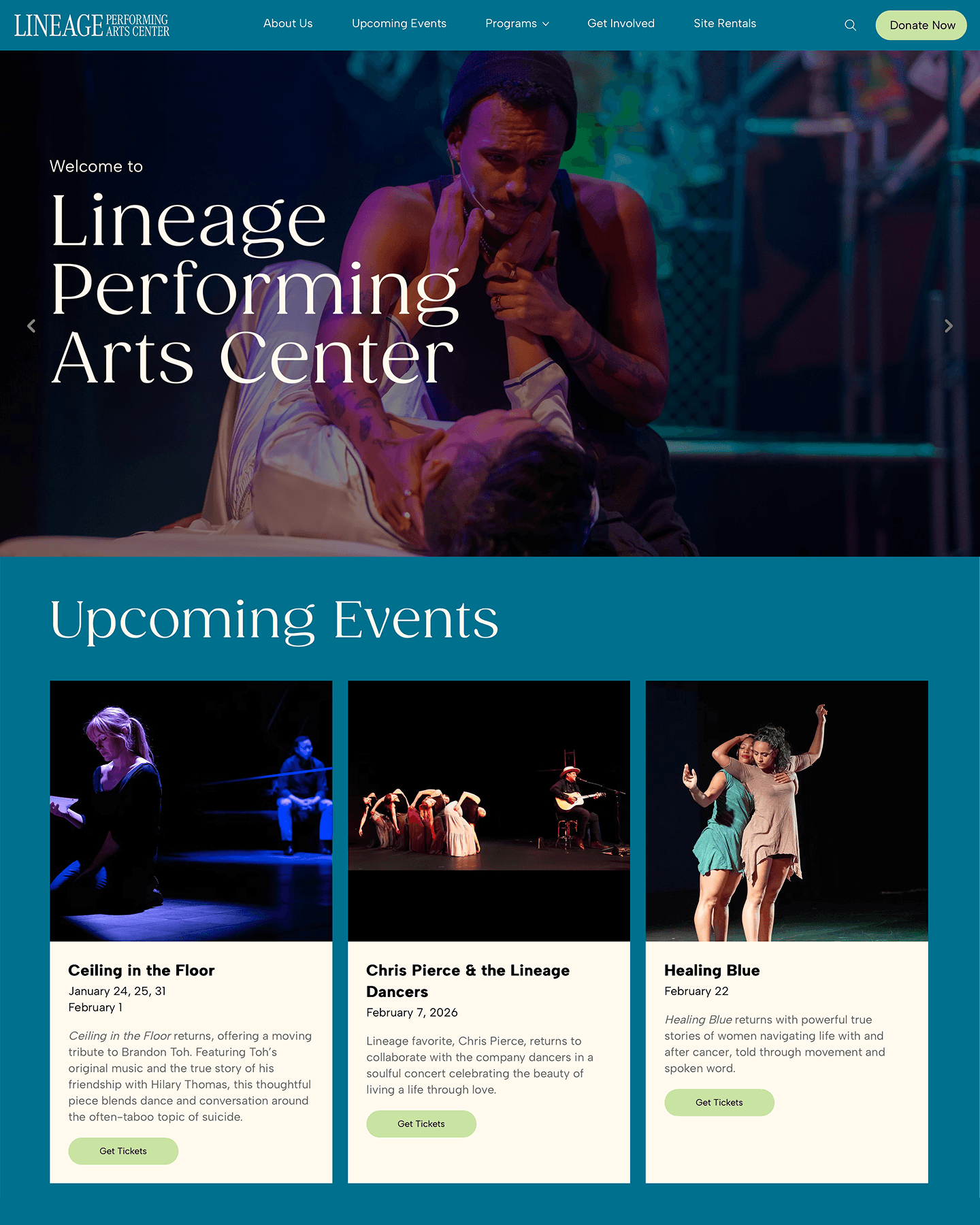
A beautiful, well-organized website that communicates Lineage's mission, and allows users to easily purchase tickets and find information.
the results
There was an increase in average pages per session from 1.4 to 2.0
There was a decrease in bounce rate (visitors who left after visiting only one page) from 71.1% to 45.0%
In user testing, 4 out of 5 participants correctly identified two or more aspects of the organization
In user testing, all participants completed ticket purchasing within 30–60 seconds
Average ease-of-use rating: 4.8 / 5
background
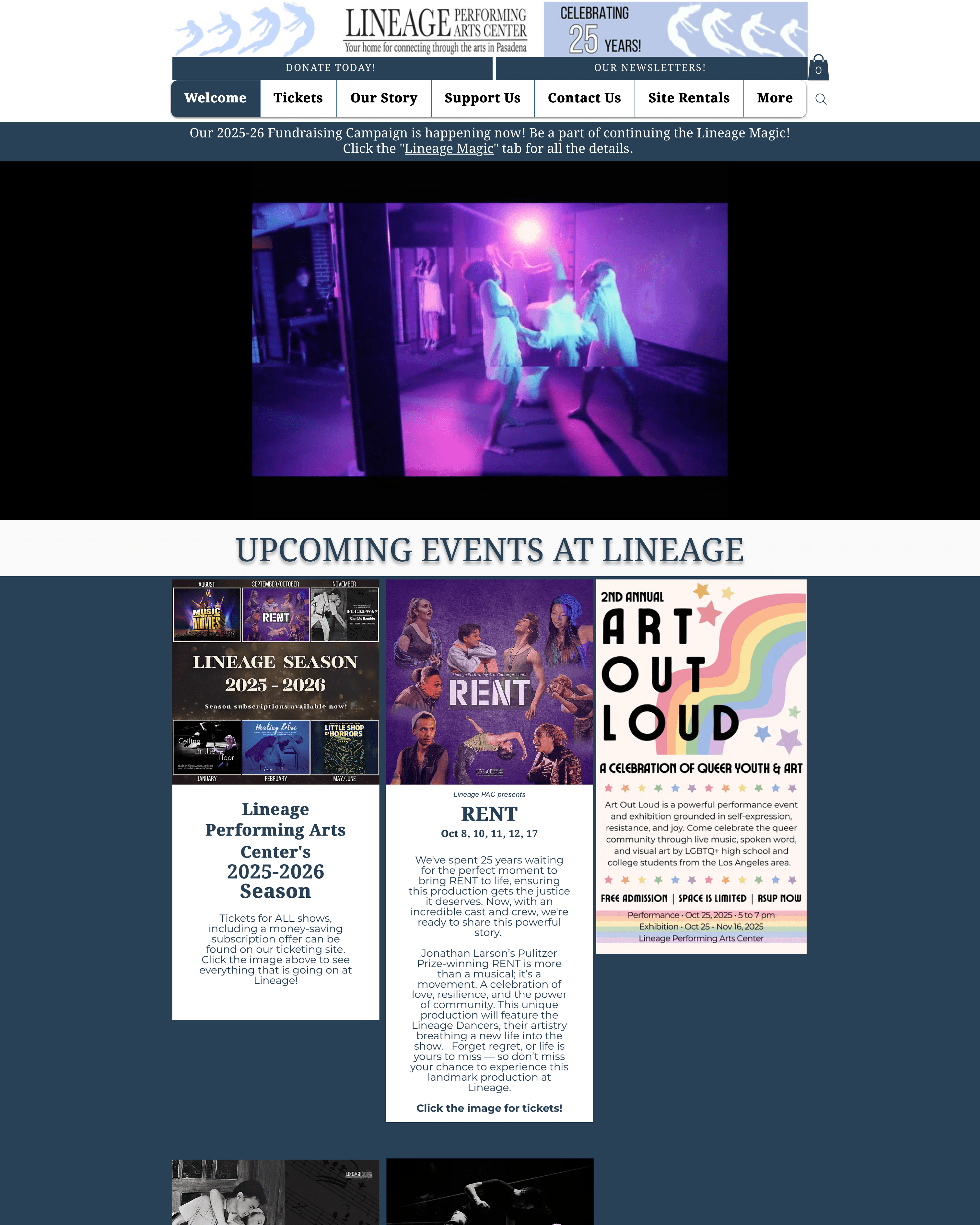
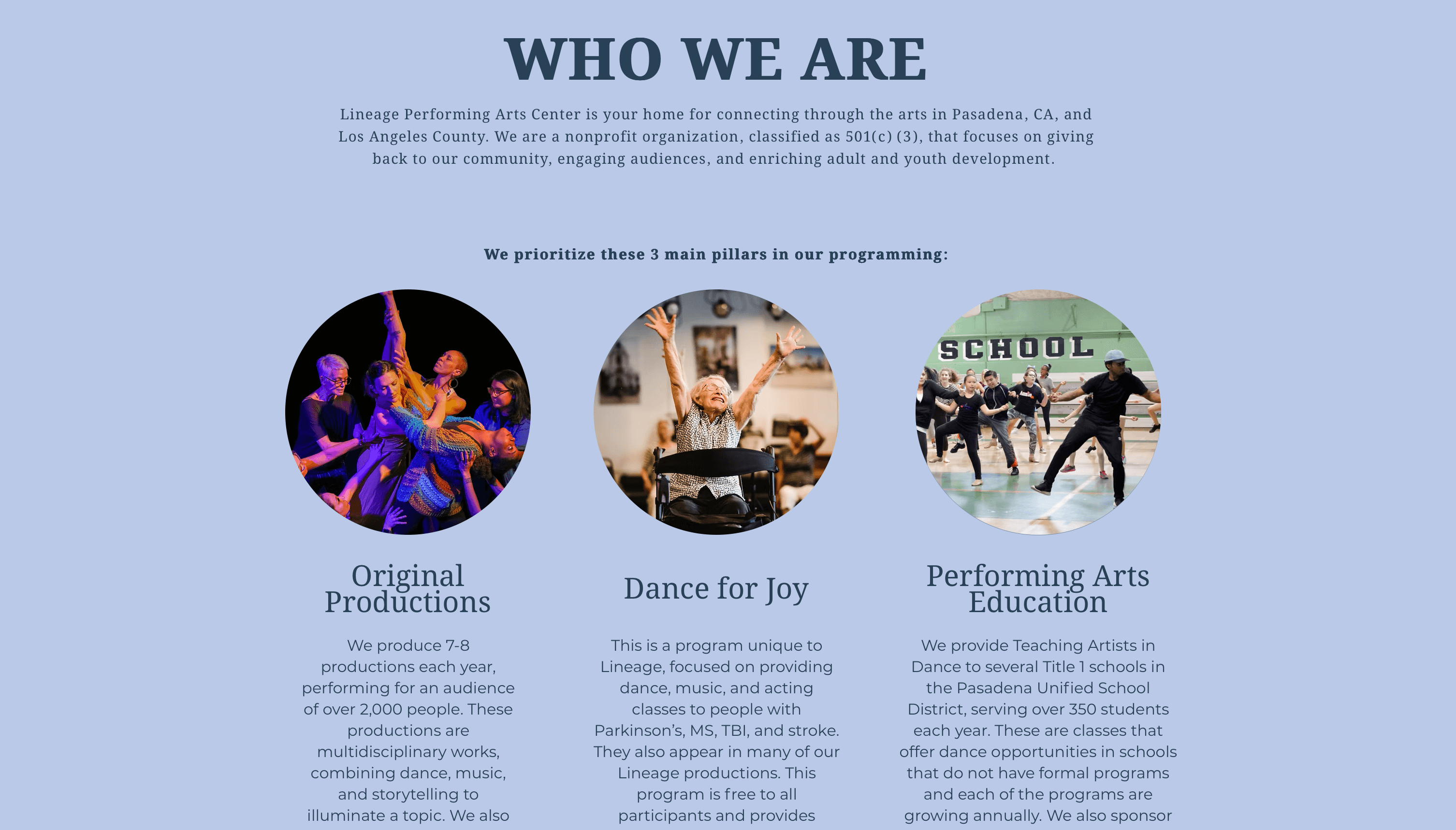
A disorganized and dated website had issues with navigation and brand representation
Lineage Performing Arts Center is a local hub for dance, music, theatre, and interdisciplinary performances, alongside classes and community outreach programs. The website supports several critical user tasks, including purchasing tickets, donating, and learning about programs and volunteer opportunities. I was brought on to redesign the site after stakeholders identified persistent issues with navigation and information discoverability, as well as a disconnect between the website and Lineage’s mission and values.
Discovery
Balancing clarity and usability with emotional warmth and trust
I began the project by meeting with stakeholders to understand their goals and constraints. They wanted to:
More accurately and professionally represent the organization
Organize information more intuitively
Make the website easier to maintain internally
Increase donations
Through these conversations, it also became clear that Lineage’s identity is deeply rooted in connection and community. Their productions often address challenging subject matter, and many audience members are repeat patrons driven by loyalty to Lineage’s mission. Any redesign would need to balance clarity and usability with emotional warmth and trust.
The Lineage community reinforces stakeholders' perception of the company
I conducted interviews with two employees and two participants in Lineage’s programs. While stakeholders had not explicitly mentioned ticket sales as a concern, employees revealed that lower-than-desired ticket sales were an ongoing challenge for the organization.
Program participants spoke overwhelmingly positively about their experiences, emphasizing the importance of communicating Lineage’s warmth, inclusivity, and sense of belonging. These qualities were seen as key differentiators that set Lineage apart from other performing arts organizations and needed to be clearly reflected in the website.
Non-affiliated users identify opportunities with ticket purchasing and aesthetics
To understand how Lineage was perceived by potential new audiences, I interviewed four unaffiliated individuals who attend arts performances at least a few times per year. Participants ranged in age from their 20s to their 60s. I wanted to:
Compare users’ impressions of the current website with how Lineage hoped to be represented
Understand what factors influence users' decisions to attend a production
Evaluate the ticket purchasing experience
Identify usability challenges and points of friction
From these users, generational differences emerged. For younger users, dated aesthetics undermined trust in the quality of the performances. Older participants were more focused on functionality, prioritizing an easy and straightforward ticket purchasing process. Together, these insights reinforced that both visual credibility and functional clarity were essential to attracting and retaining audiences.
Define
Finding the overlap in stakeholder and user goals
Synthesizing insights from all interviews revealed that users consistently prioritized clear, concise information and intuitive navigation, closely aligning with stakeholder goals. A major usability challenge also surfaced around the integration between the website and the external ticketing platform. Because users were required to leave the website to purchase tickets, many were confused by duplicated information, inconsistent branding, and unclear navigation between the two sites.
Although there were many business and user goals, they ultimately fell into three primary categories:
More clearly and authentically represent Lineage’s mission and values
Increase ticket sales and donations
Improve organization, navigation, and overall information clarity
Projected business outcomes to the new website
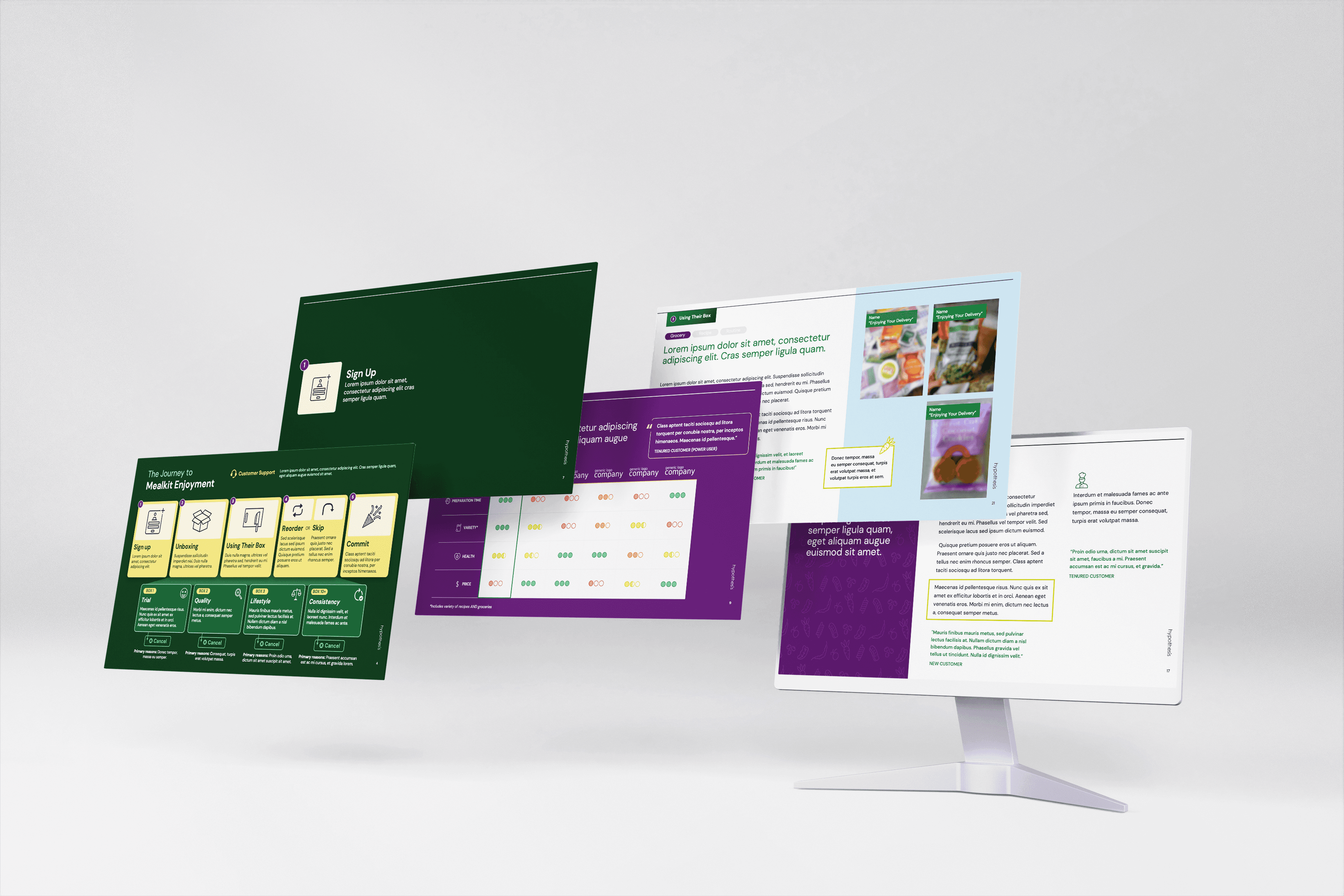
Clarity and frictionless ticketing are industry standard with competitors and need to be table stakes
With goals clearly defined, I conducted a competitive analysis to:
Identify design elements that convey brand personality and emotion
Analyze how other organizations integrate ticket purchasing
Examine how competitors balance comprehensive information with limited user attention
Findings:
Competitors used distinctive typography and dramatic photography to evoke emotion associated with the performing arts
Most either embedded ticketing widgets directly into their sites or maintained neutral branding when redirecting users externally to avoid confusion
Information was kept minimal on landing and events pages, with individual show pages offering more detail for users who wanted to learn more.

This analysis reinforced that emotion, clarity, and frictionless ticketing are industry standards and needed to be table stakes for Lineage.
Develop
Creating a more intuitive information architecture
To support the goals of simplifying content and improving maintainability, I conducted a full content audit and worked with stakeholders to determine what could be removed or consolidated. For non-essential content, we weighed the value to users against the ongoing maintenance burden placed on staff.
Before
"Our Story" was a catch-all for different types of content and it wasn't obvious that "Lineage Magic" was a special fundraising intitiative.
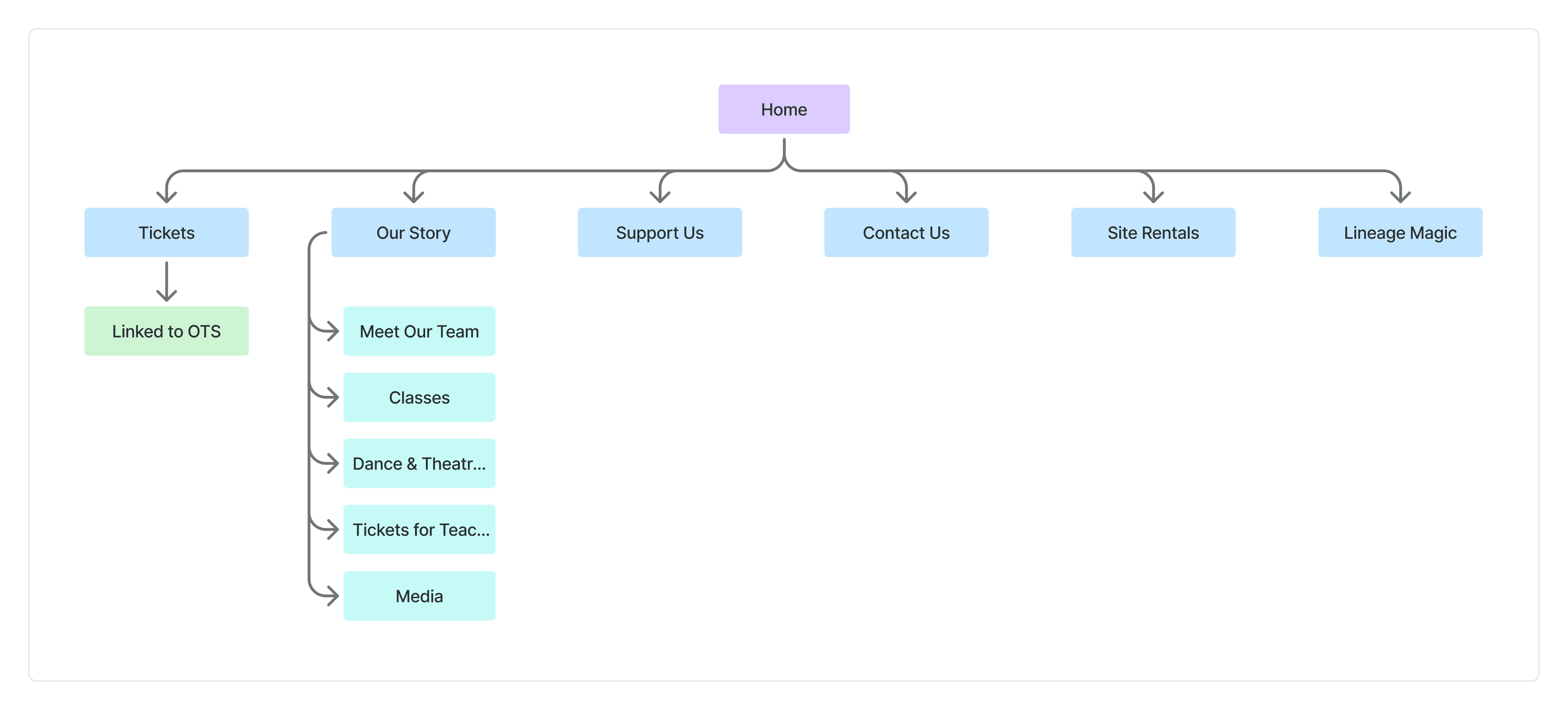
After
"Upcoming Events" was added and "Classes" and "Education" were given their own pages.
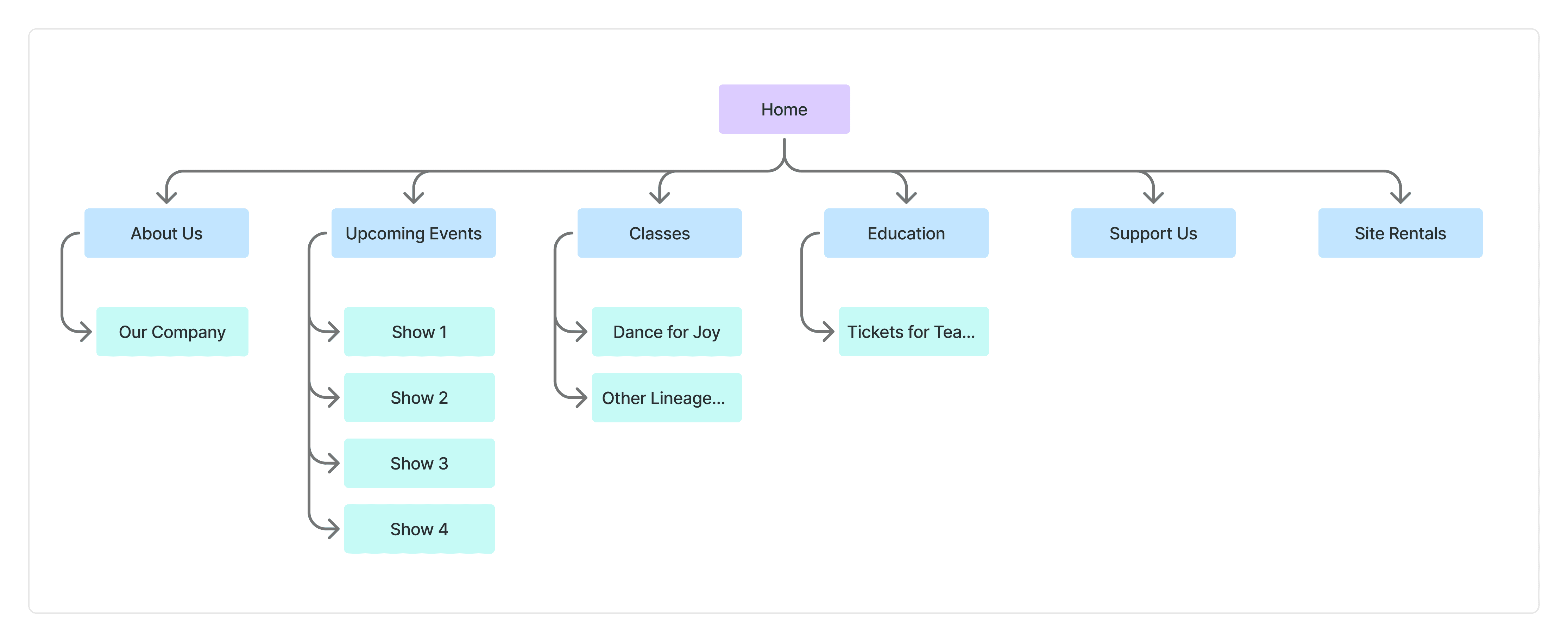
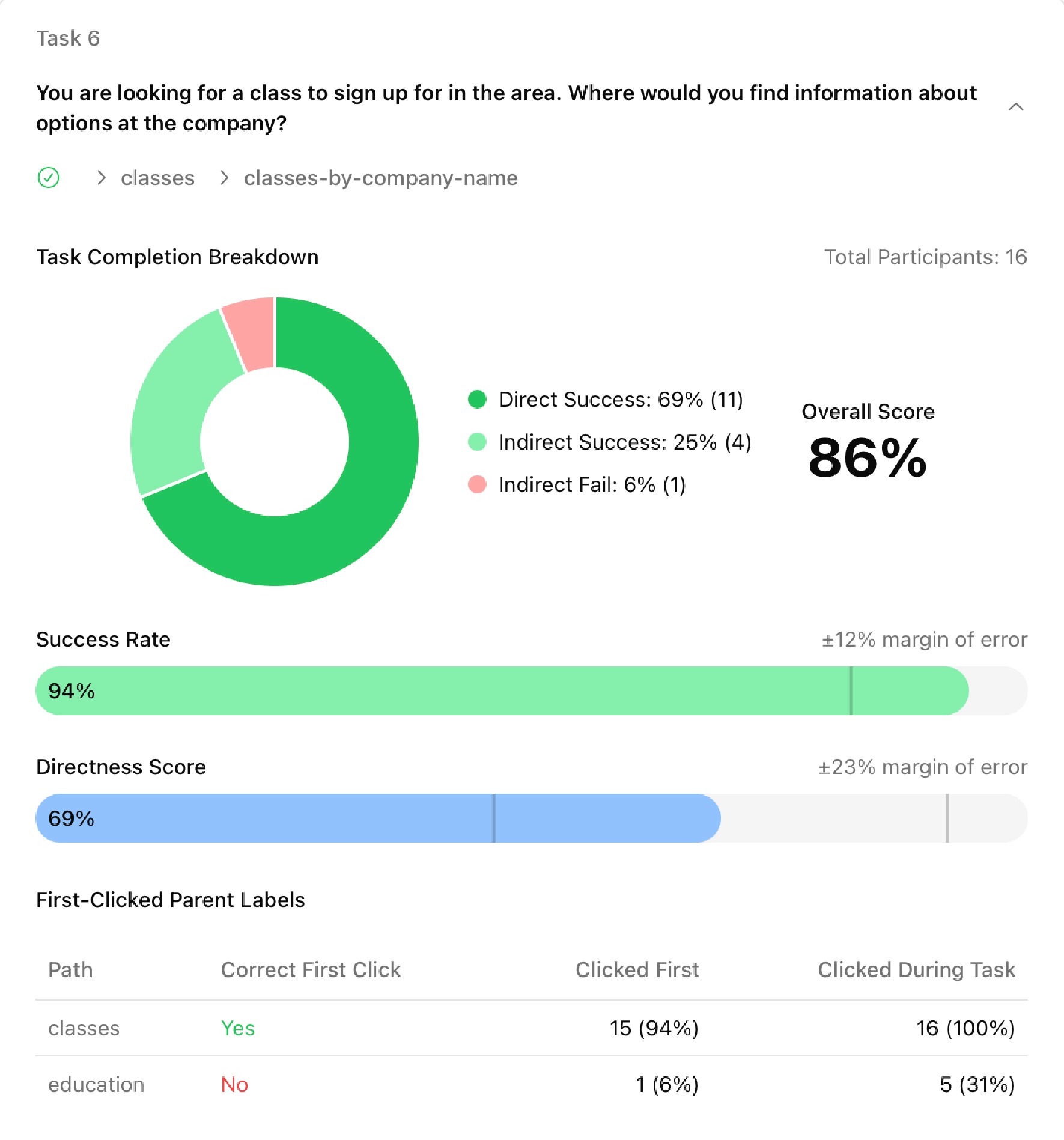
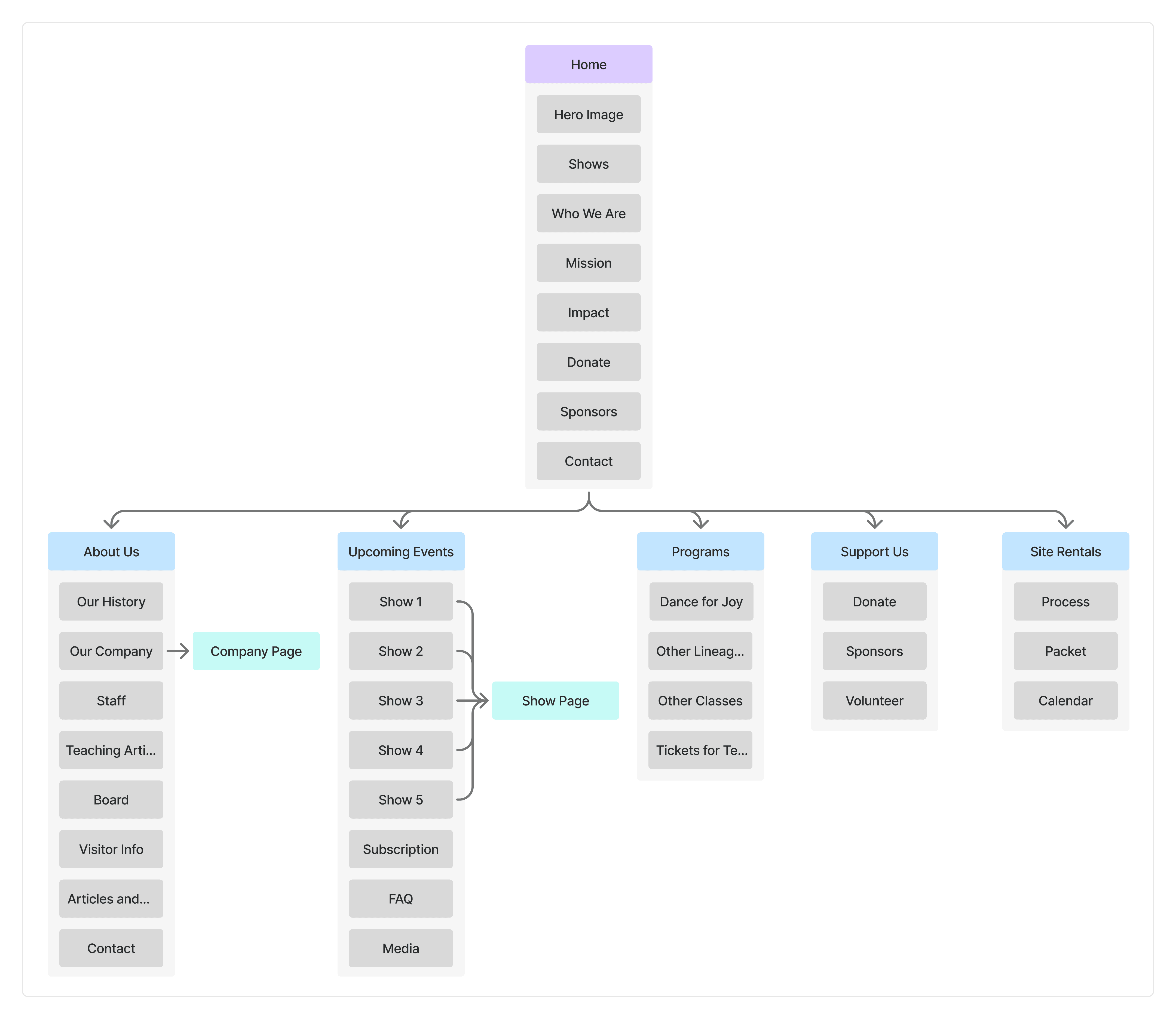
Using this refined content set, I validated the new information architecture through tree testing with 16 participants. Testing revealed confusion between “Classes” and “Education,” as Lineage programs often bridge the two categories. In response, and after stakeholder discussions, we consolidated these offerings into a single “Programs” page that more closely matched users’ mental models.
Final sitemap
Content for each page was determined and sub-pages kept minimal.
Deliver
Considering technical constraints and maintenance load when designing
Lineage already had a subscription to Wix and there was not sufficient justification for the cost and labor of migrating to a new platform. Instead, I recommended upgrading from the basic Wix editor to Wix Studio, which allows for full responsiveness and more advanced design control.
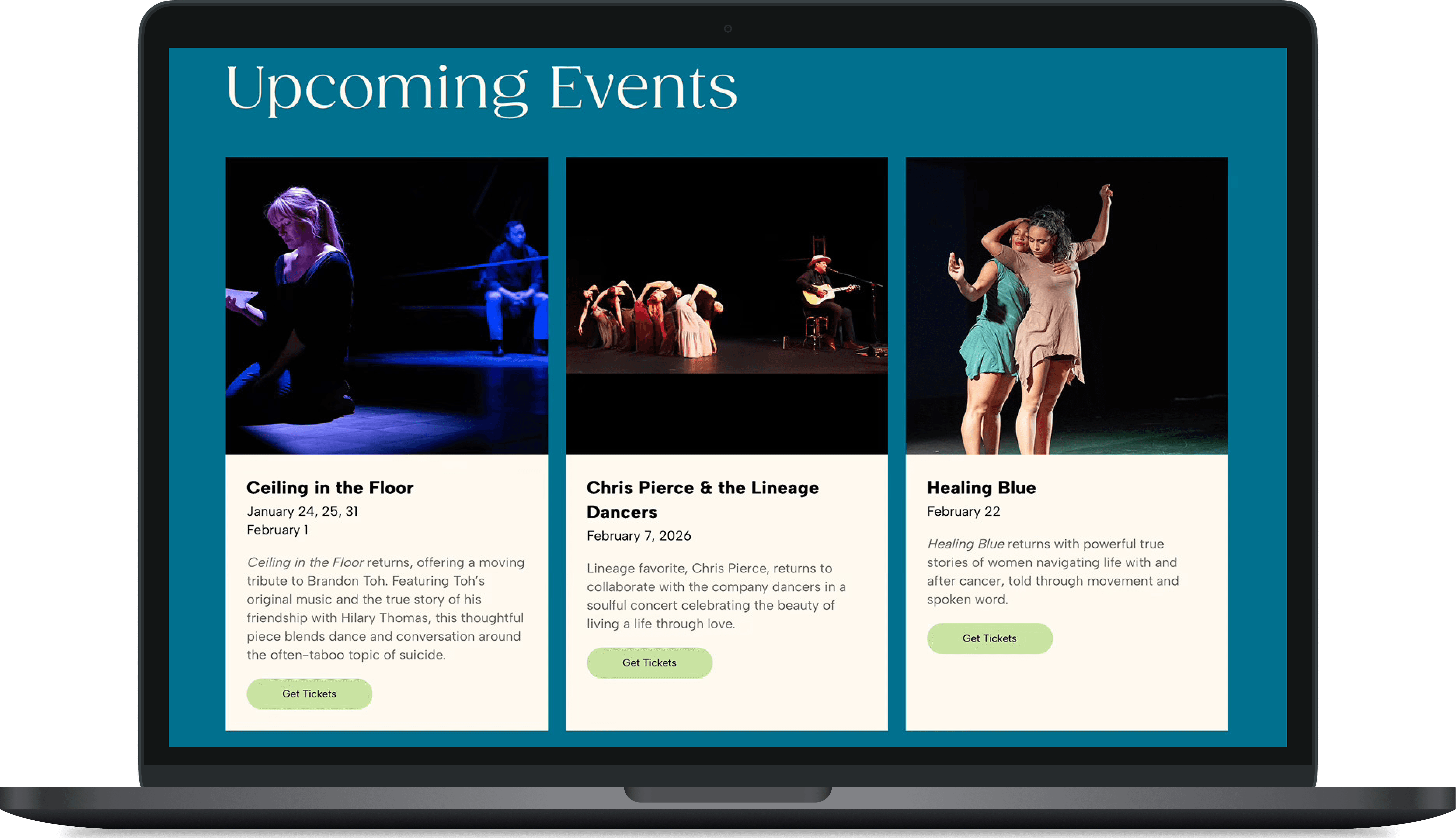
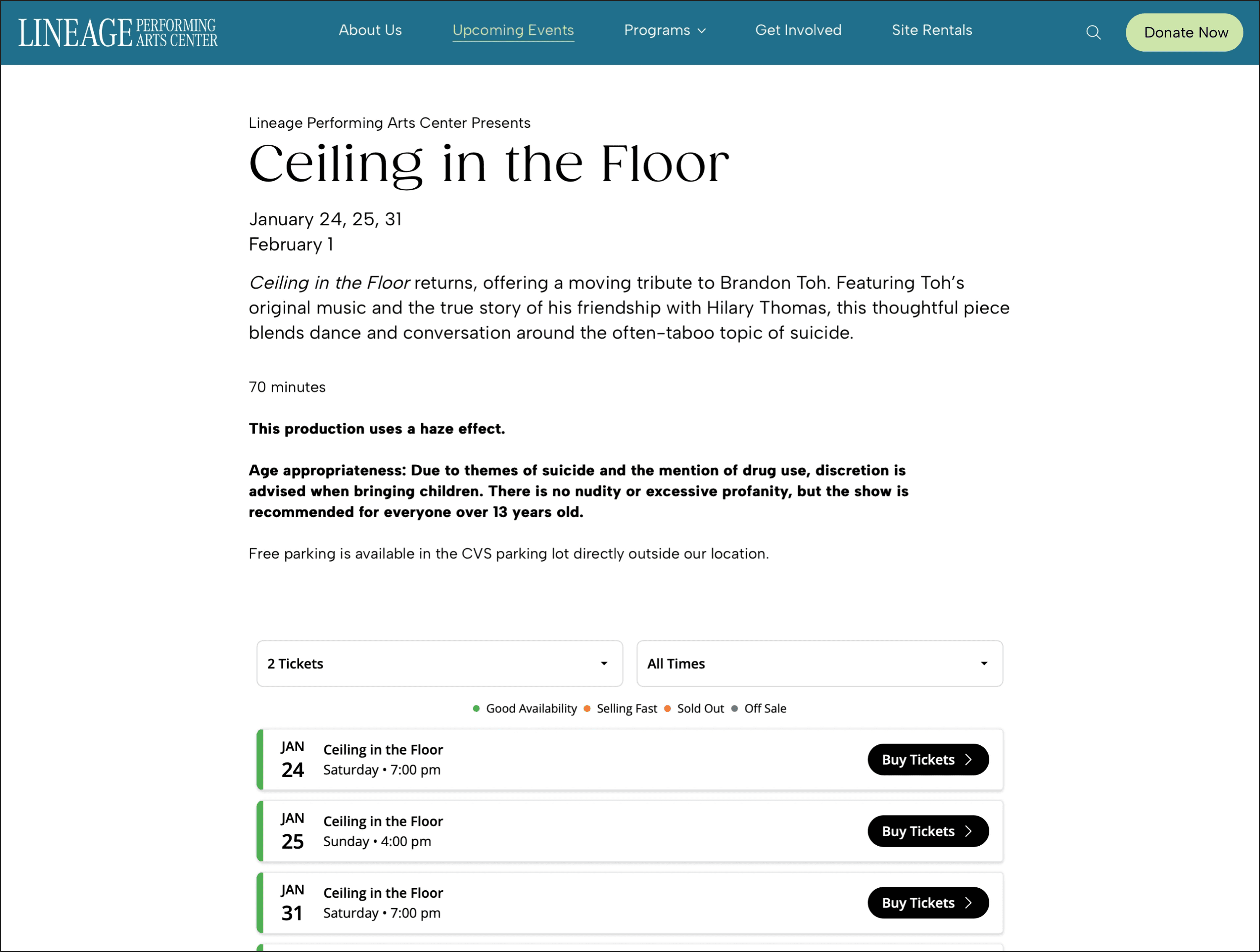
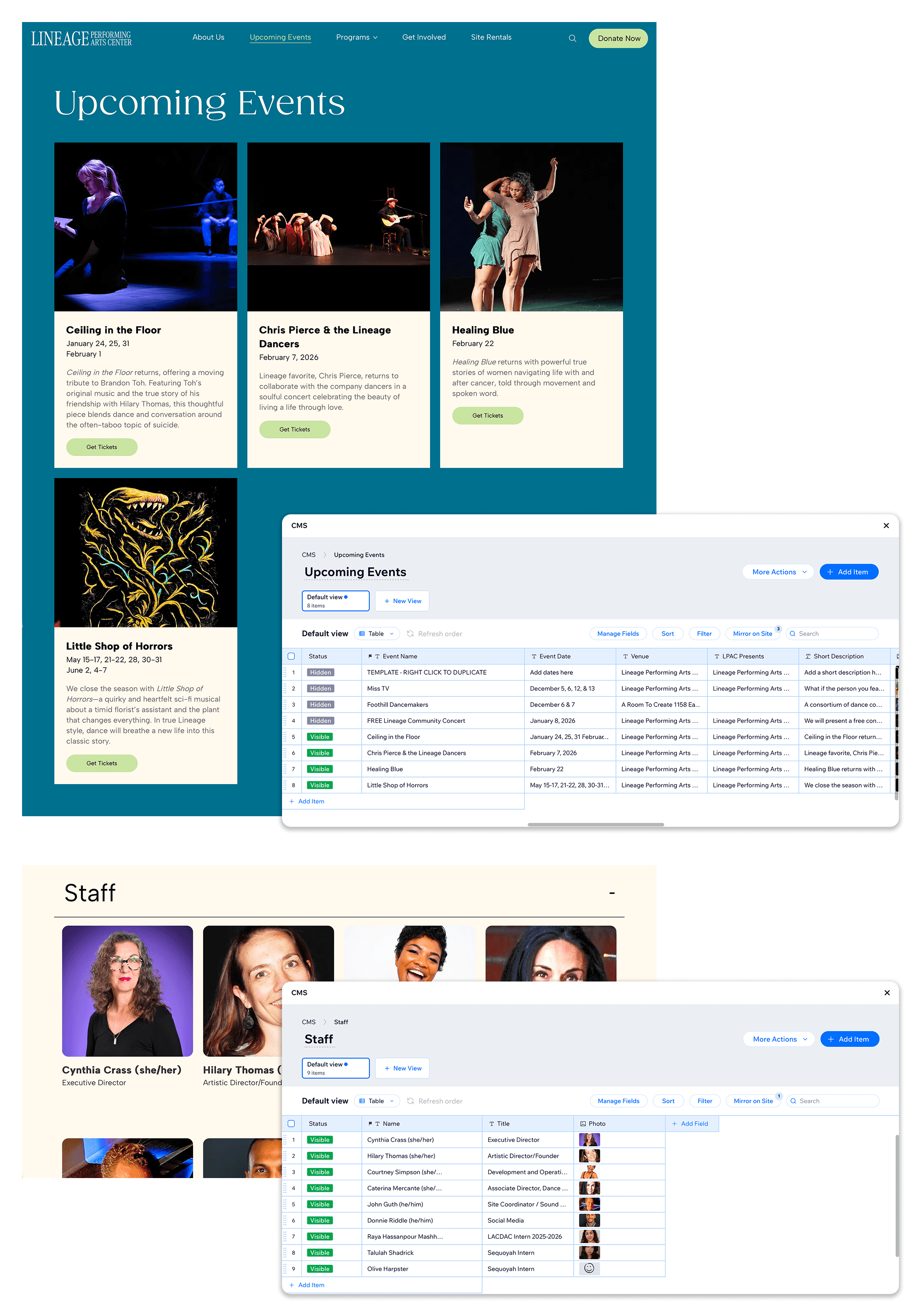
Maintenance considerations informed many design decisions. Individual show pages were built using a content management system connected to dynamic pages, allowing new pages to be created automatically without redesign work. Staff members, classes, and programs were also managed through CMS collections, reducing the need for manual updates across multiple pages. This approach ensured scalability for future shows and reduced staff maintenance burden.
CMS
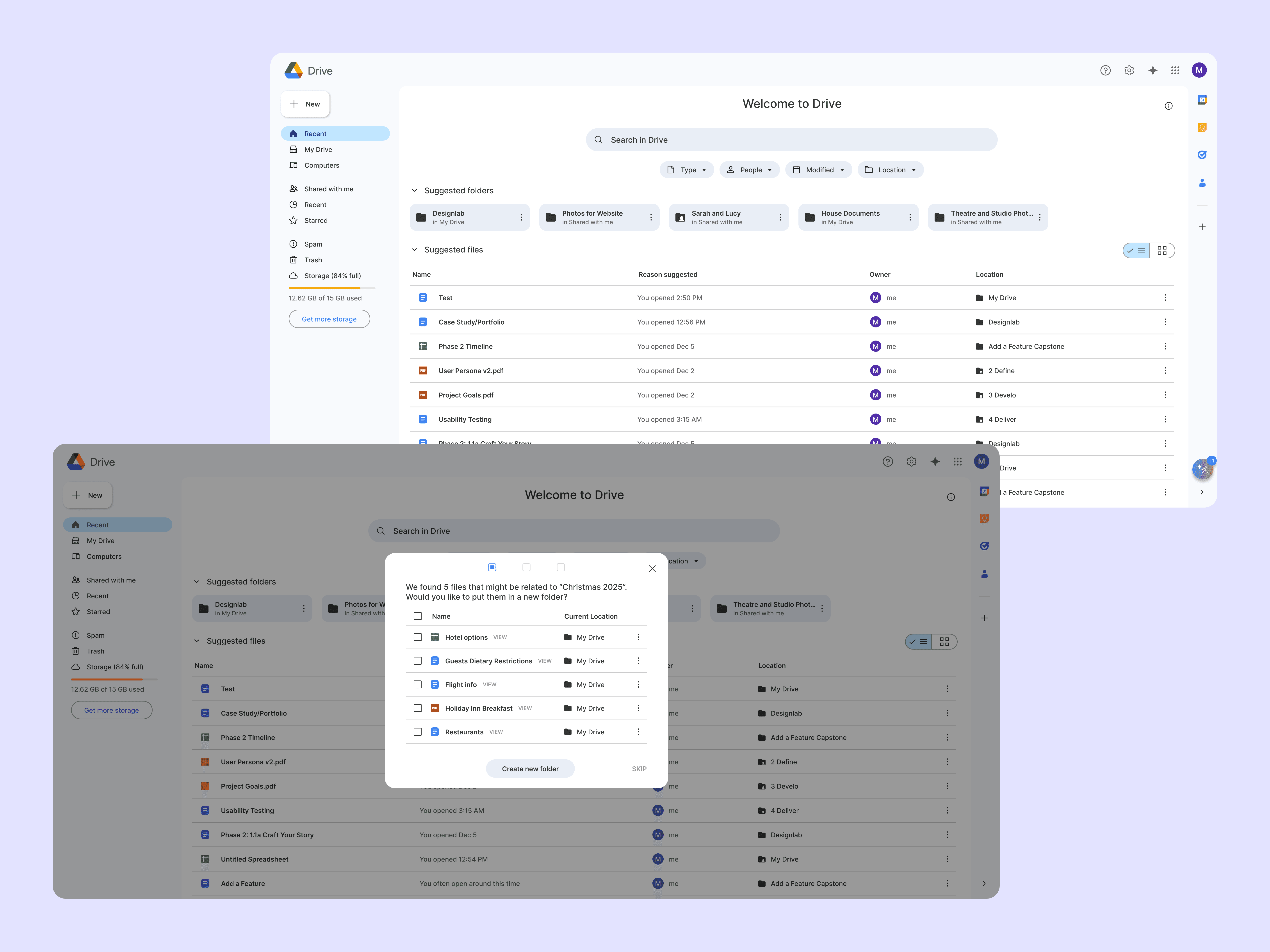
I used content management systems to govern any information on the website that would need to be frequently changed, such as upcoming events or staff.
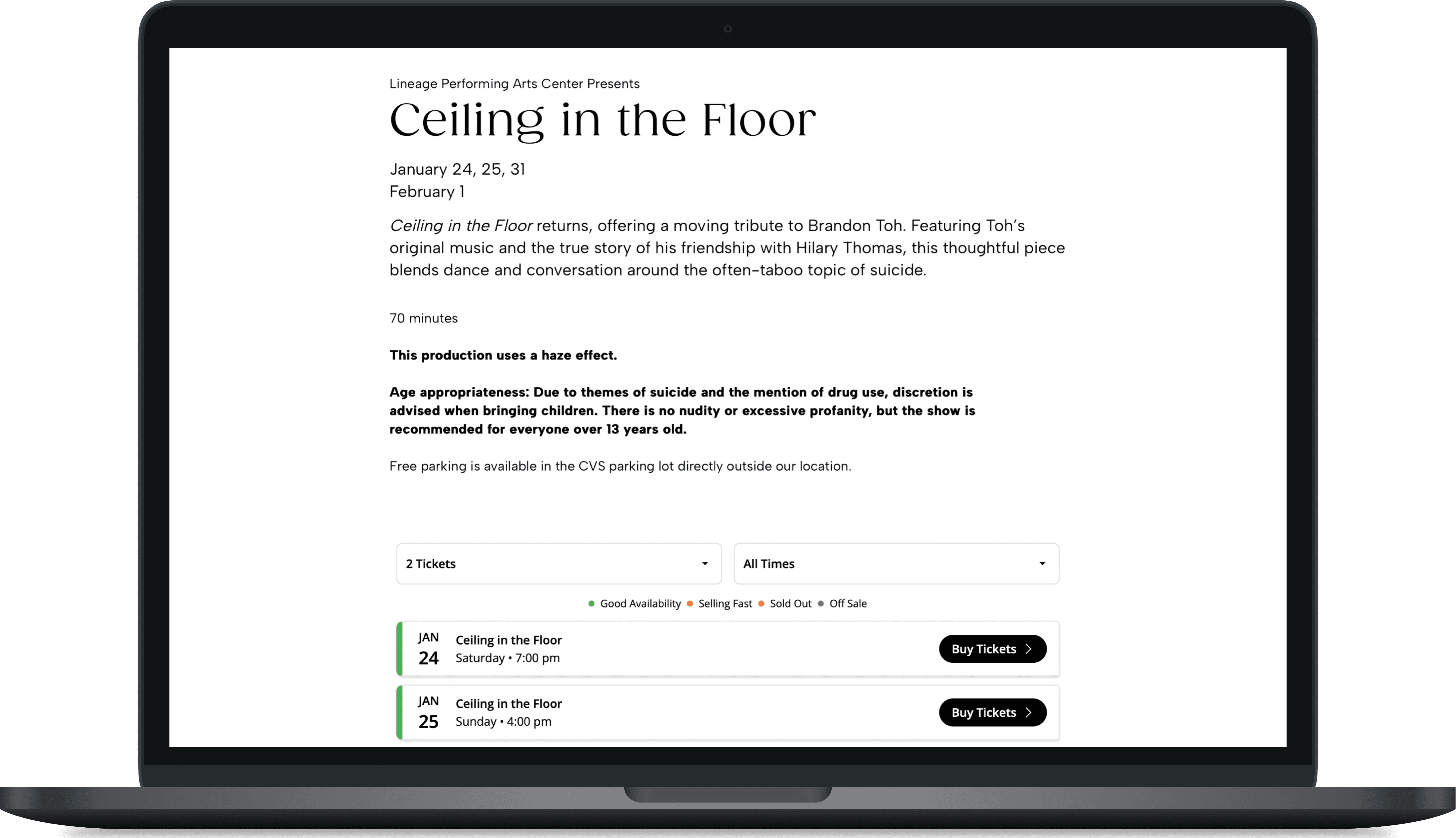
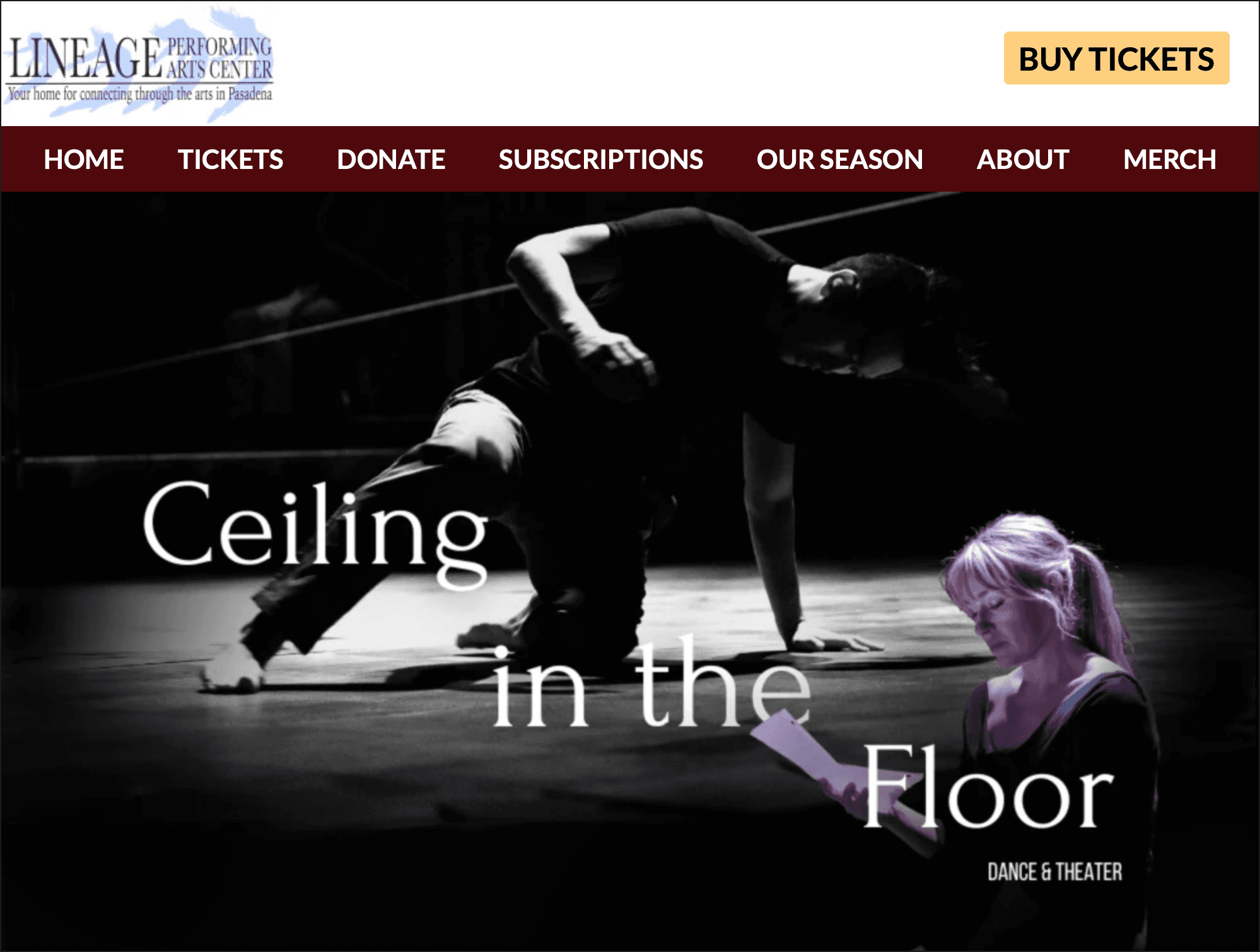
A key objective was minimizing the need to send users to the external ticketing site. I initially considered stripping the branding and complexity of the ticketing site, to reduce users’ confusion. When the platform limited the ability to do this, I decided to invest time in incorporating widgets that could be embedded directly into the Lineage website. Users were able to complete purchases and make donations without leaving the site, significantly reducing confusion and friction.
Users found the new website design significantly improved in appearance and usability
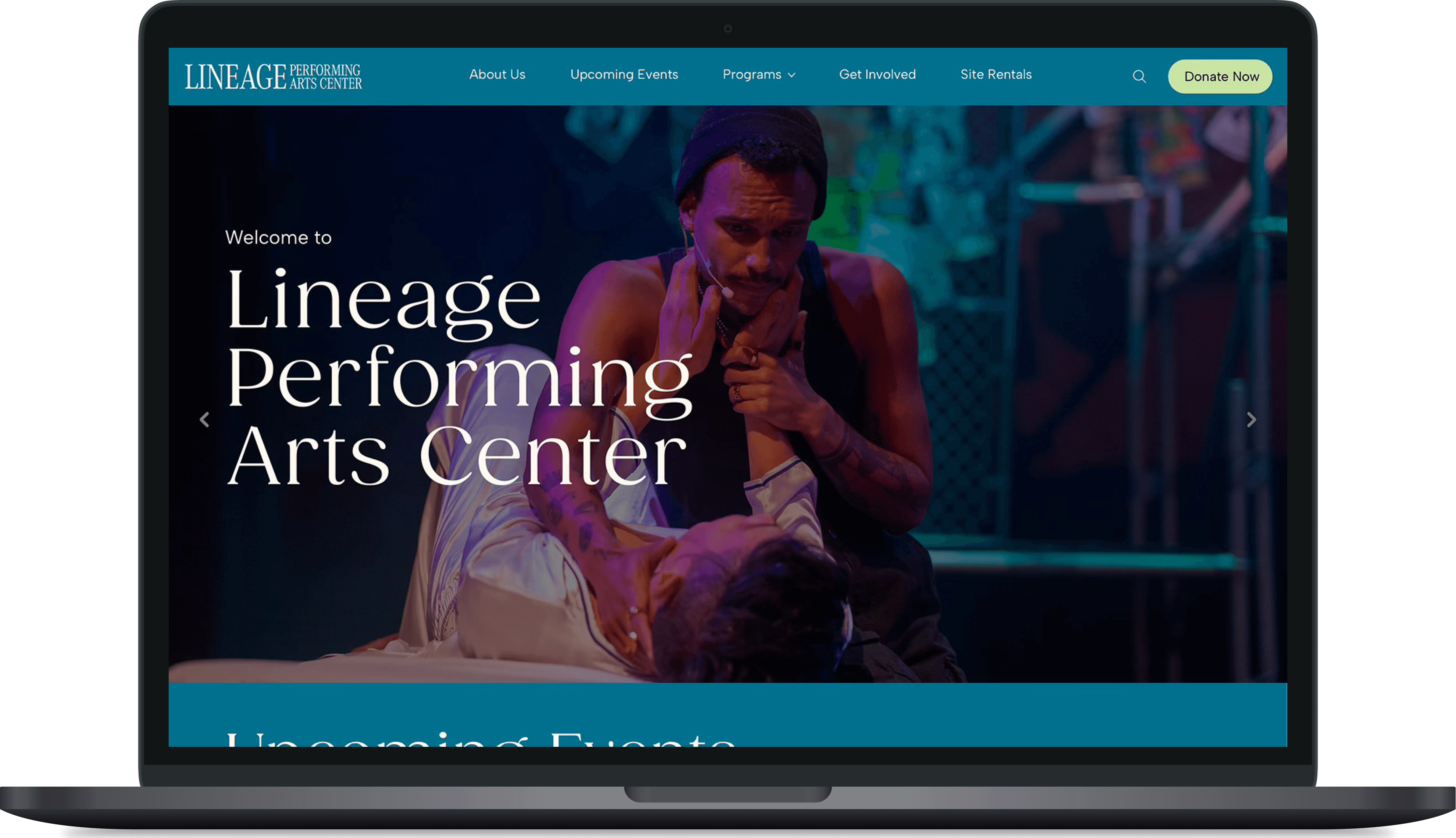
I conducted usability testing with five participants: three from the original unaffiliated interview group and two new users. All participants expressed a strong preference for the redesigned website. Users described the updated branding as “welcoming,” “community-oriented,” and “inclusive,” and characterized the ticket purchasing flow as “easy,” “clean,” and “seamless.”
Home Page
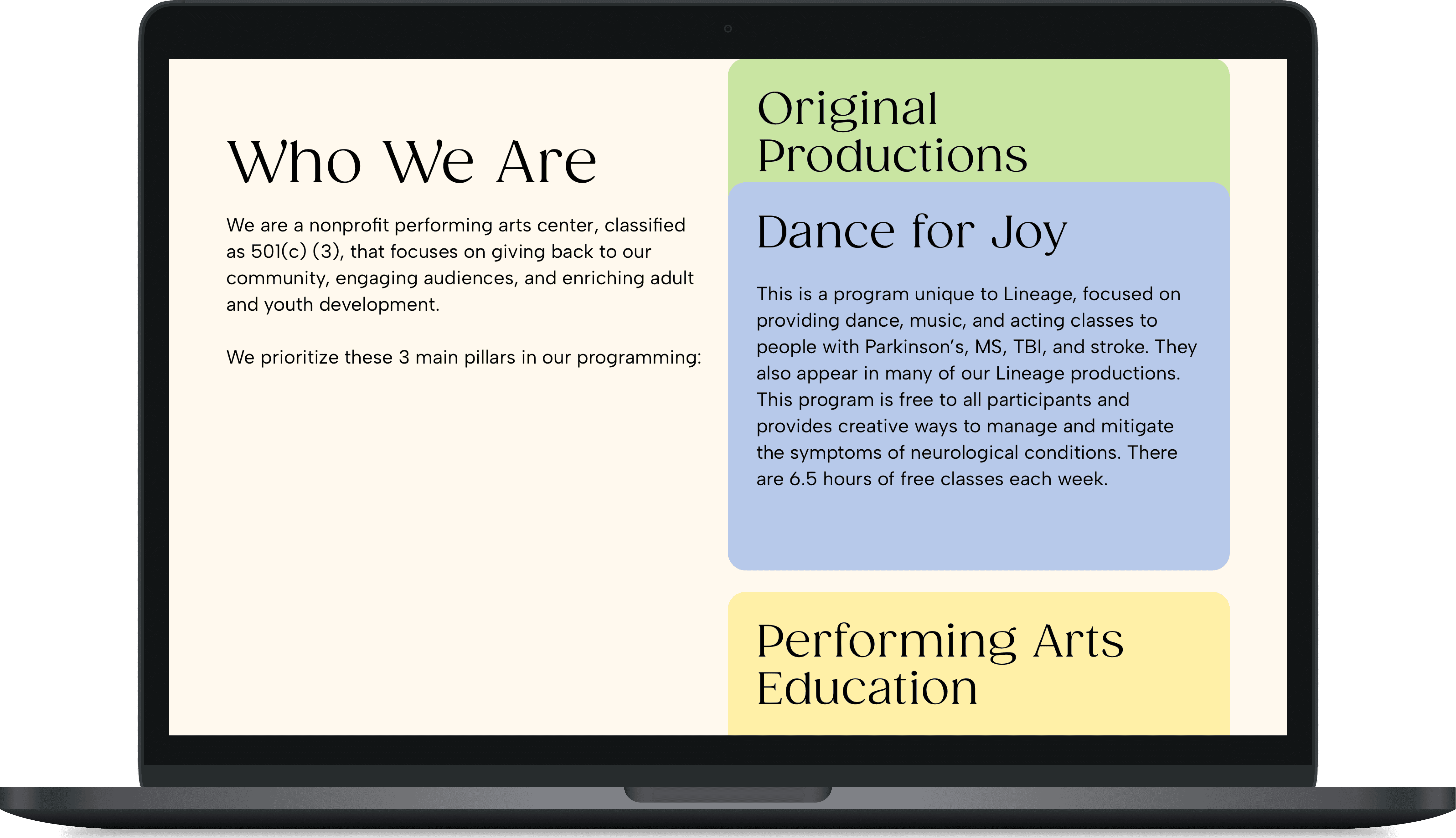
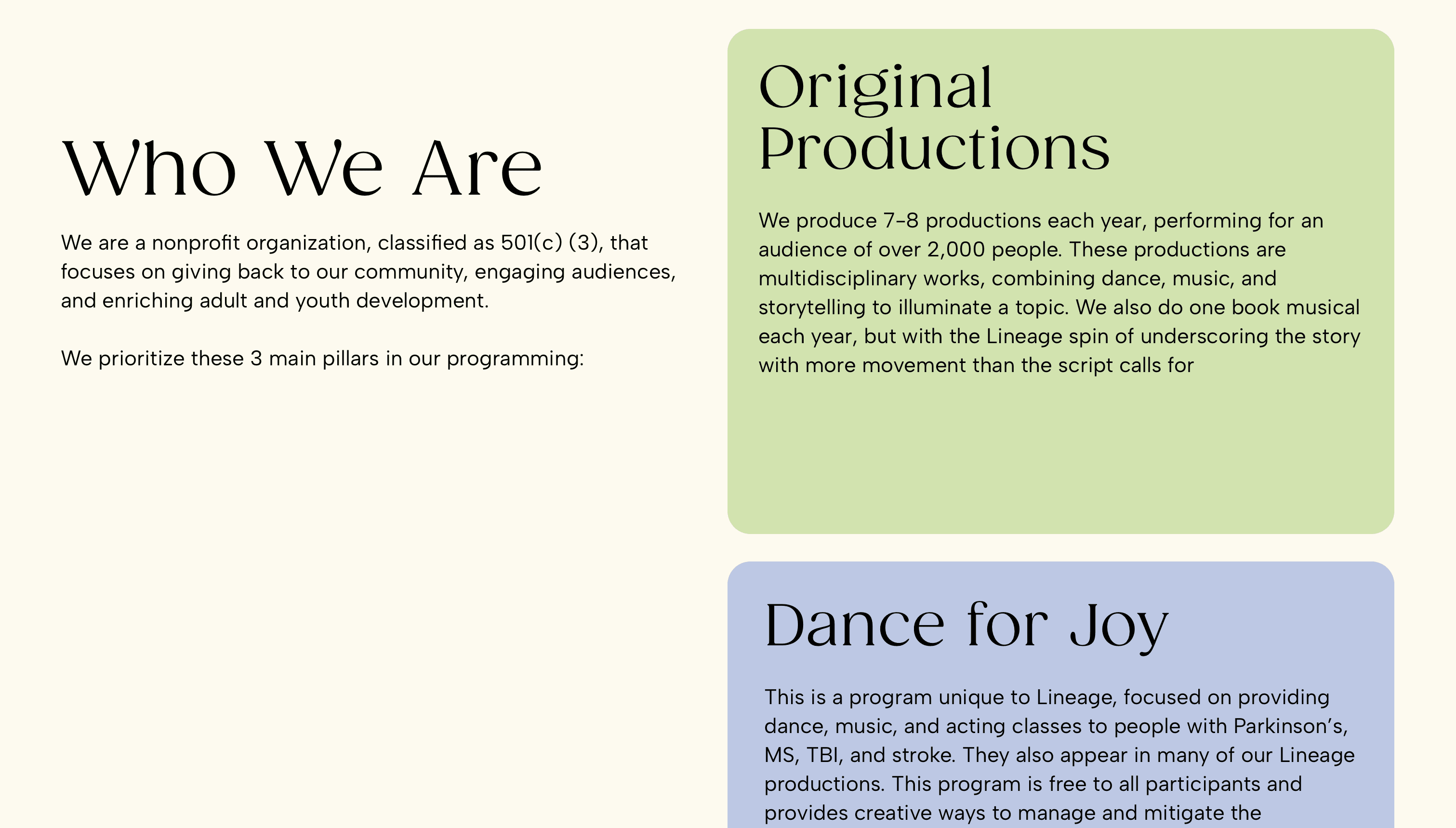
About the Company
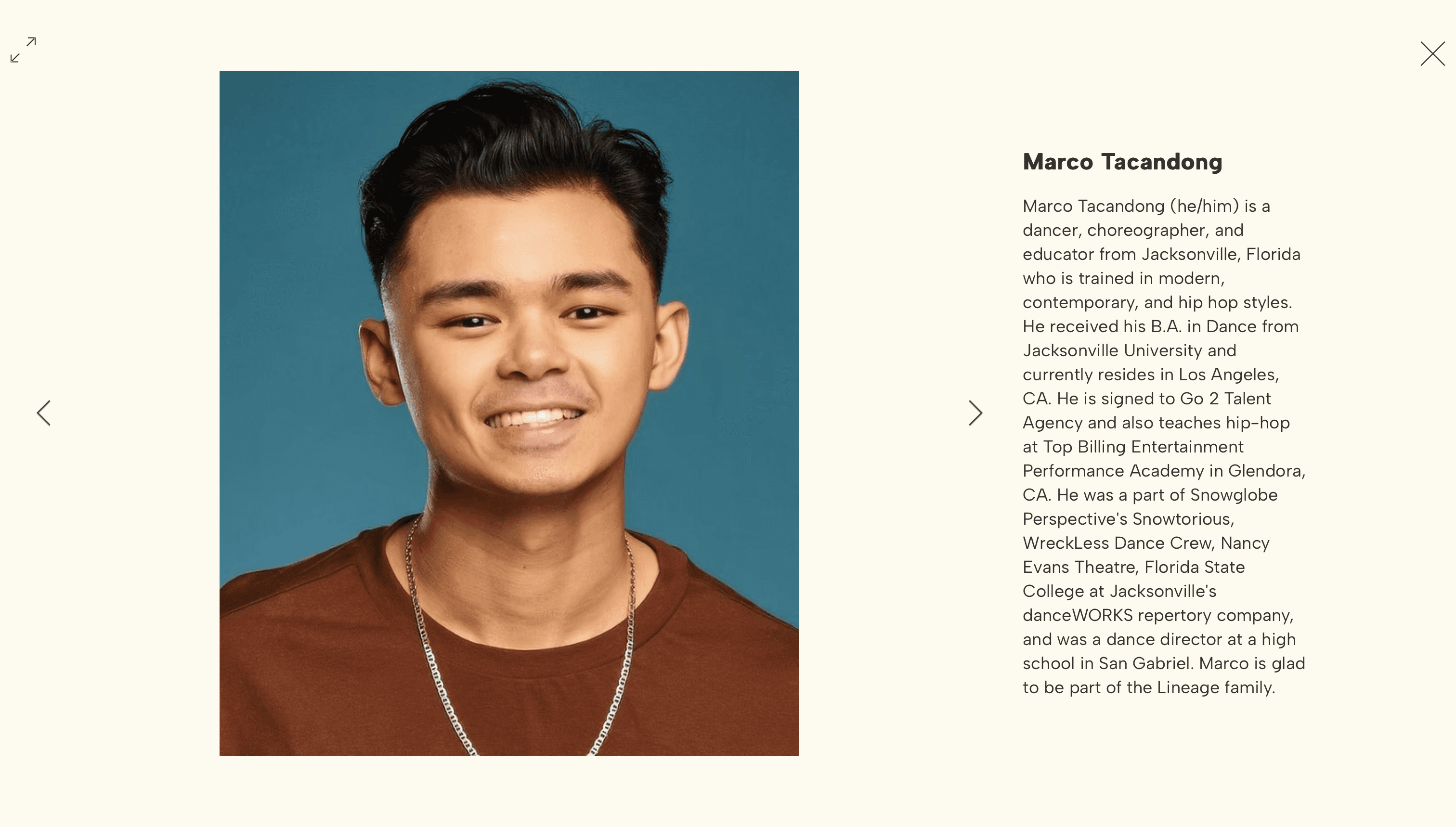
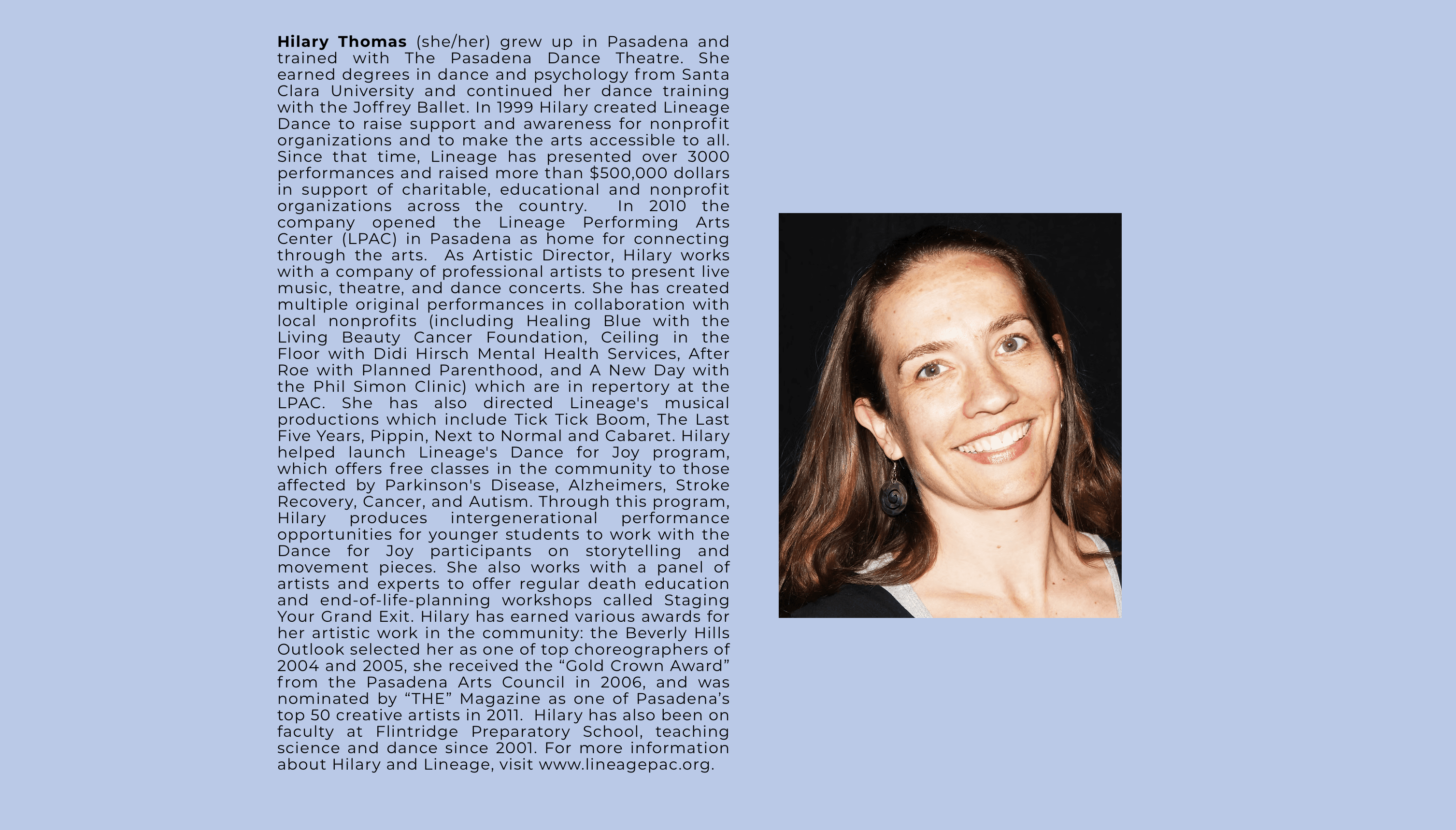
Artist Biographies
Metrics
4 out of 5 participants correctly identified two or more aspects of the organization
2 out of 5 participants mentioned Lineage’s nonprofit status without prompting
5 out of 5 participants successfully followed the correct ticket purchasing flow
Average ease-of-use rating: 4.8 / 5
All participants completed ticket purchasing within 30–60 seconds
5 out of 5 participants successfully navigated the donation flow
Outcome
Delivering clarity without losing warmth
This project required balancing emotional storytelling with functional clarity, while working within technical and budgetary constraints. By restructuring the information architecture, simplifying navigation, and embedding ticketing and donation flows directly into the site, the redesign significantly reduced friction for first-time users while reinforcing emotional resonance for returning patrons. Users were able to quickly understand what Lineage does, why it matters, and how to participate.
Usability testing confirmed that the redesign not only improved task completion rates, but also changed perception. Participants described Lineage as established, inclusive, and community-oriented, qualities that stakeholders and program participants identified as core to the organization’s mission, but which were previously absent from the website experience.
Impact
Increase in average pages per session from 1.4 to 2.0
Decrease in bounce rate (visitors who left after visiting only one page) from 71.1% to 45.0%
Next steps
Monitoring ticket sales and donation data post-launch to validate long-term impact
Improving staff and performer photography