Supporting healthier social media habits without hard restrictions
Users wanted to reduce their social media use, but existing tools relied too heavily on hard limits. I designed a mobile app centered on gradual goals, low-lift alternatives, and positive reinforcement to help users cut back in a way that felt realistic and sustainable.
time frame
4 weeks
client
Independent Project
role
UX Researcher, UX/UI Designer
the problem
Users struggle to cut back on social media use, but existing restriction tools don't work.
🤔
How might we provide “restrictions” in a way that users actually stick to.
The Solution
An encouraging app that focuses on gradual reduction, low-lift alternatives, and positive reinforcement to help users reduce unwanted social media use.
the results
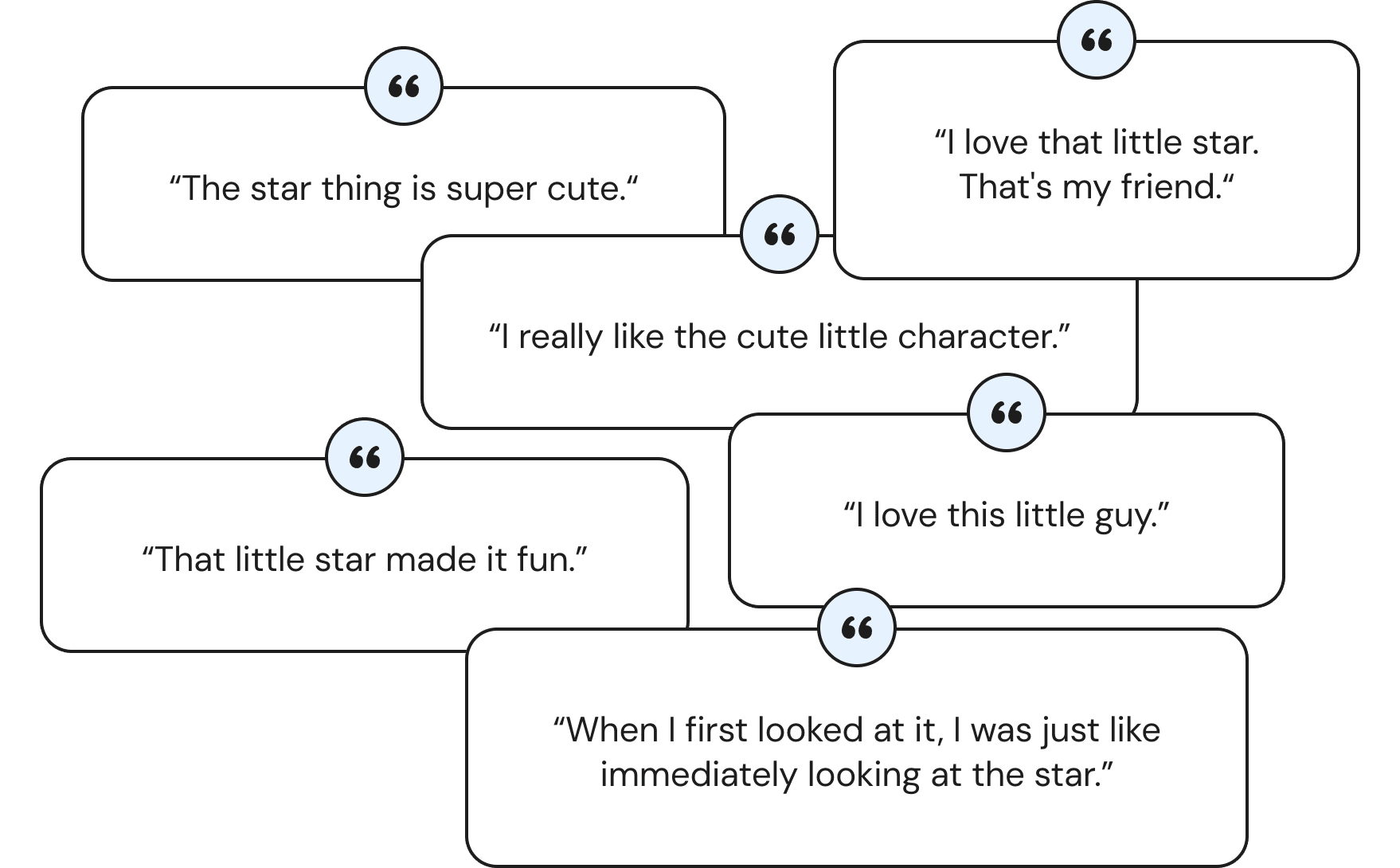
Users expressed enthusiasm for the app mascot
In testing, users rated goal setting 4.7/5 for ease of use
In testing, users rated the alternatives 4.75/5 for helpfulness in redirecting them away from a restricted app
background
Approaching social media reduction from a new angle
As of 2024, the average social media user spends about 2.5 hours per day on social media. Research has linked heavy social media use to increased depression and anxiety, lower impulse control, and other negative effects. Because social media can also trigger dopamine-driven reward loops, quitting entirely can be difficult. While there are many options for social media blocking apps or plugins, existing products tend to focus on restriction. My hypothesis was that while people are already aware of social media’s harmful impact, the limited ways of supporting behavior change are making it harder for them to actually reduce usage.
discovery
Users struggle to cut back on social media as an automatic coping mechanism for boredom
To understand the problem space, I interviewed eight users who either wanted to reduce their use of social media or had already attempted to do so. Across interviews, a few patterns emerged consistently.
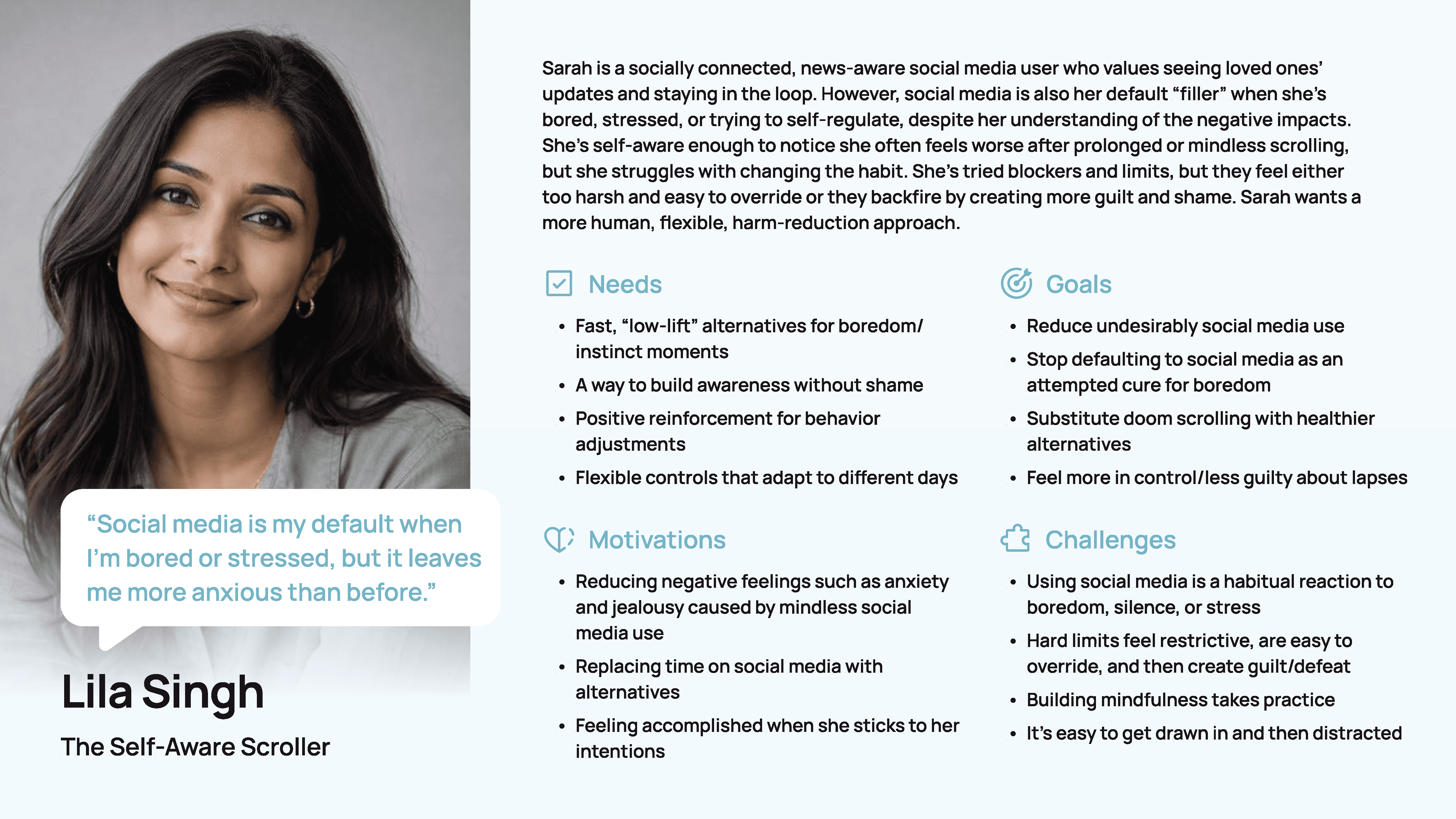
Unwanted social media use often happened out of habit, boredom, or a need to decompress. Users described social media as an automatic coping mechanism.
They were aware of the negative effects on their attention, mood, and overall wellbeing and some felt frustrated because they struggled to change their behavior.
Users who had tried blockers didn’t find them to be entirely successful. They felt overly restrictive, too easy to override, or both. Overriding the tool often added another layer of guilt and disappointment.
Define
Replacing strict restriction with a supportive, harm-reduction approach
While users lamented how easily they could override blockers, I was not convinced that making a stricter blocker would actually solve the problem. Users spoke with more nuance about what they needed. Some wanted flexibility because their days varied. Others disliked hard restrictions because they felt infantilizing, anxiety-inducing, or didn’t build the self-awareness and accountability needed for long-term change.
Strict restriction could actually inhibit long-term behavior change. It may increase attention toward the thing that is perceived as scarce or limited and reduce users’ ability to make healthy decisions. I became interested in approaching the problem through a harm reduction lens: helping users reduce unwanted behavior in a realistic, supportive way rather than trying to eliminate it through force.
With that framing in mind, I developed four user problem statements, along with POVs and HMW questions, to guide ideation.
With many existing tools, a novel concept could have significant impact
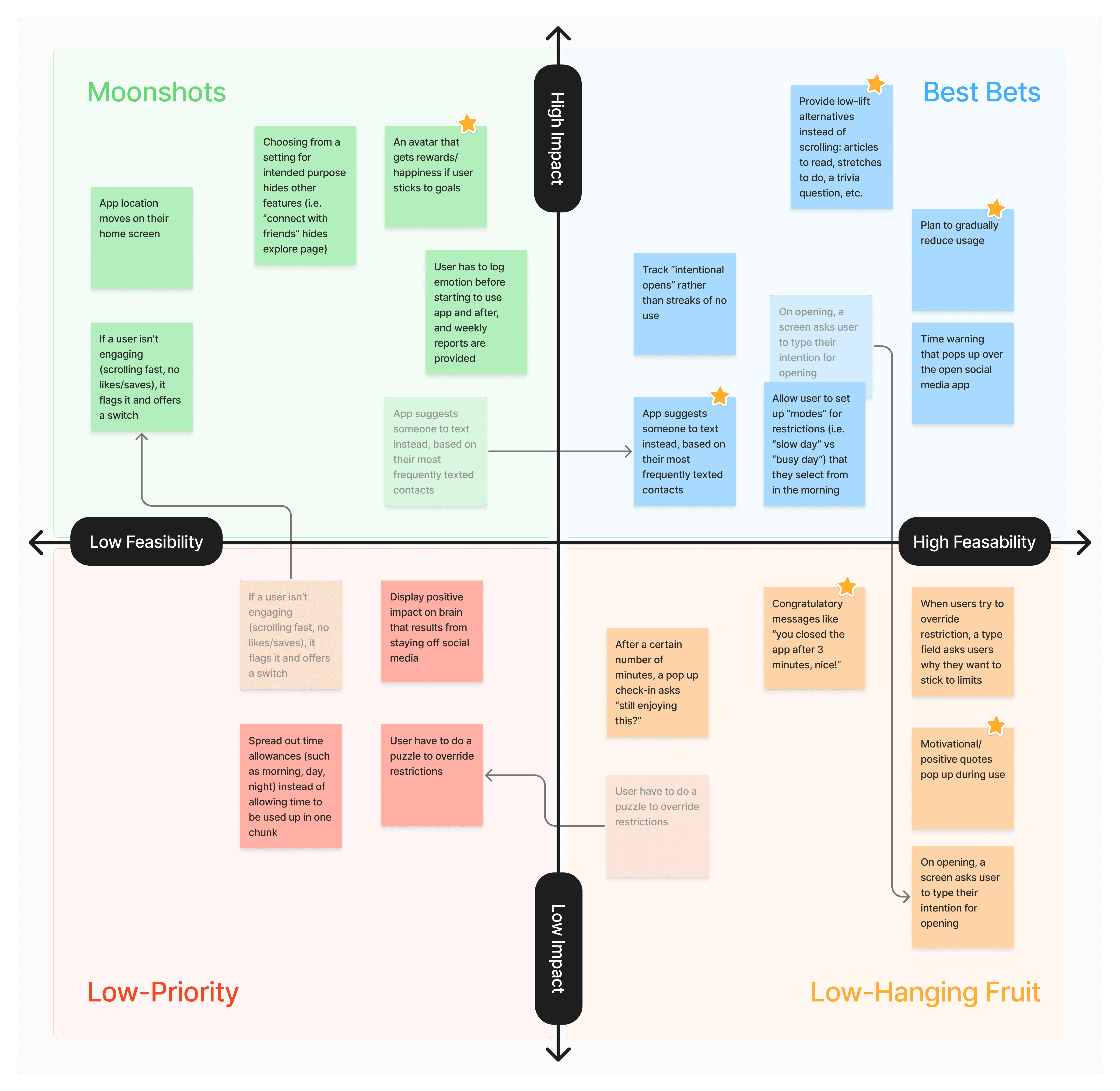
I brainstormed a range of potential solutions to these problems and mapped them on an impact feasibility matrix. My initial gut feeling was that there were many feasible solutions, but the tool needed a systematic approach, rather than disconnected features.
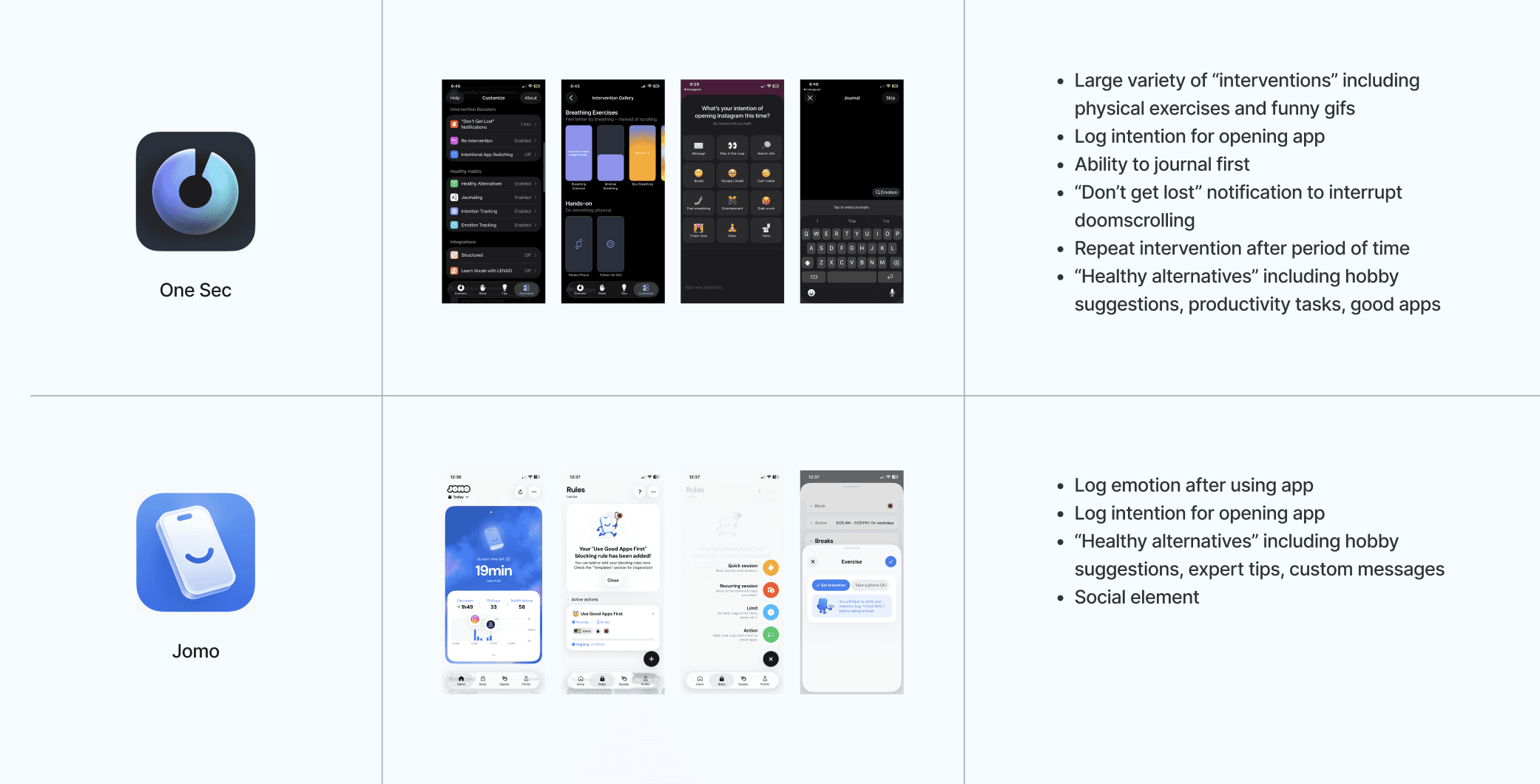
I took a pause to study existing apps more closely. I found that there were already apps that:
Employed creative unblocking methods (waiting x seconds, using a different app first, etc.)
Incorporated intentionality through methods like journaling
I revised the impact feasibility matrix, taking into consideration the novelty of the concept when evaluating impact.
Impact Feasability Matrix
Many potential solutions seemed feasible, but the approach wasn't unified. I revised the matrix based on the untapped opportunities in the market.
I chose to focus on a concept built around three ideas working together
Why this approach?
Users have a better chance of success by focusing on small steps
Providing healthier alternatives give users another outlet when they need a break or to decompress
Keeping the alternatives similar enough to social media (i.e. other phone activities) makes it easy for users to choose to do them
Positive reinforcement reframes the goal as a challenge to do something good (reduce usage) rather than trying to avoid something negative
Rewards facilitate a sense of joy and fun in accomplishing users’ goals
Develop
User testing two methods of positive reinforcement: a "virtual pet" vs. real-life rewards
After sketching low-fidelity wireframes, I reduced the product to the features necessary for a minimum viable product (MVP). Users would be provided a weekly plan to support gradual change, and low-lift alternatives to social media. For positive reinforcement, I explored two possible directions:
A “virtual pet” users could customize with rewards earned by meeting goals
Real-life rewards users chose for themselves, such as coffee or another treat
I conducted testing to determine users’ preference for the positive reinforcement method, as well as uncover any usability issues. Users responded positively to both the weekly plan and the alternatives suggestions. Preferences around rewards, however, were split. Participants articulated benefits and drawbacks to both concepts, and no strong consensus emerged.
Virtual Pet
Rewards
After reviewing the results with my mentor, I reconsidered whether a reward feature that depended on additional phone interaction was appropriate for users already trying to reduce phone-based habits. Based on that concern, I moved forward with self-provided rewards.
Deliver
Designing an encouraging and whimsical prototype
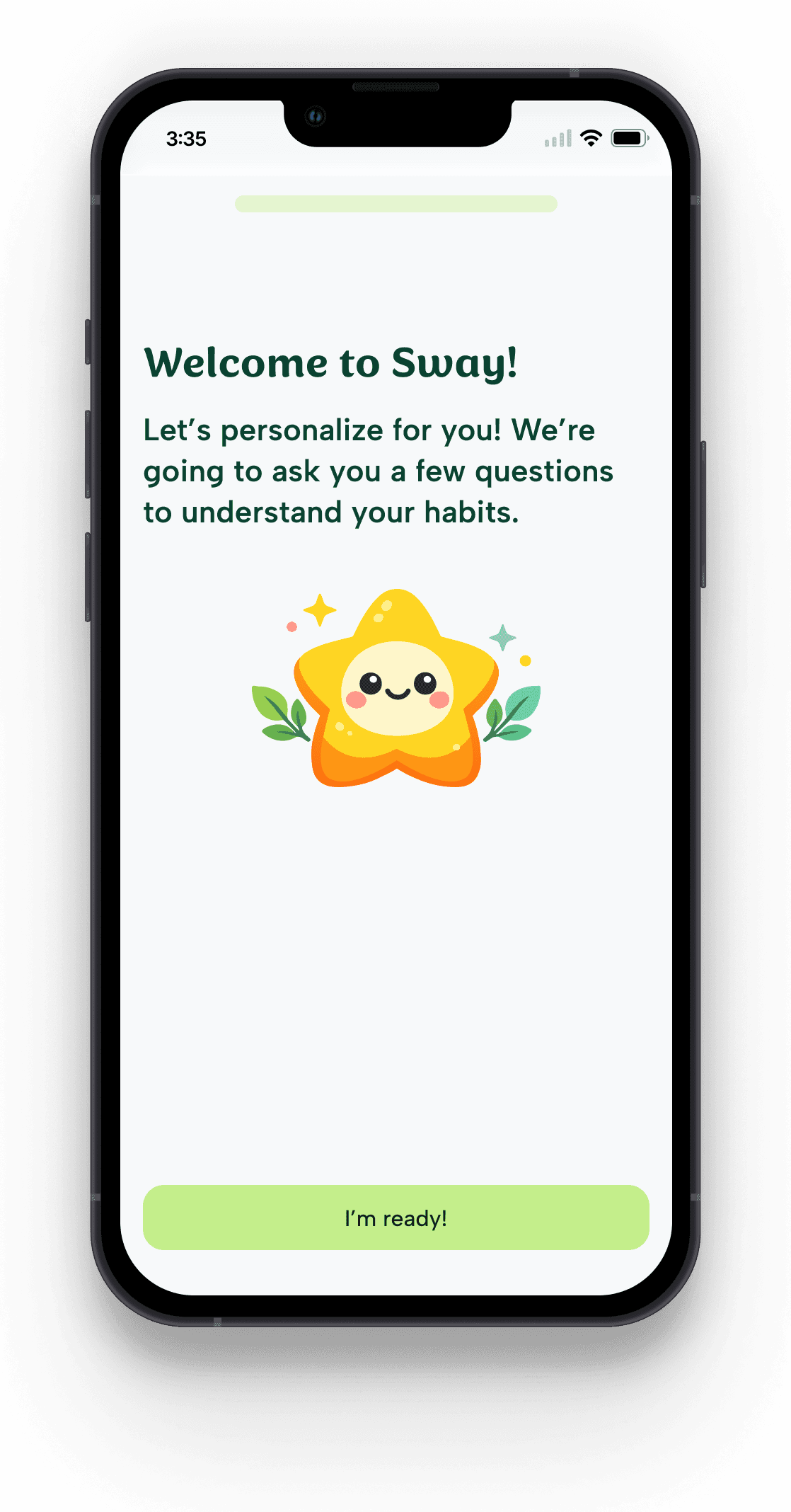
As the concept developed, I used the emotional tone of the product to guide both branding and interface design. Rather than making the experience corrective, I wanted it to feel supportive, approachable, and whimsical. These values informed the visual system, tone of voice, and interaction patterns throughout the high-fidelity prototype.
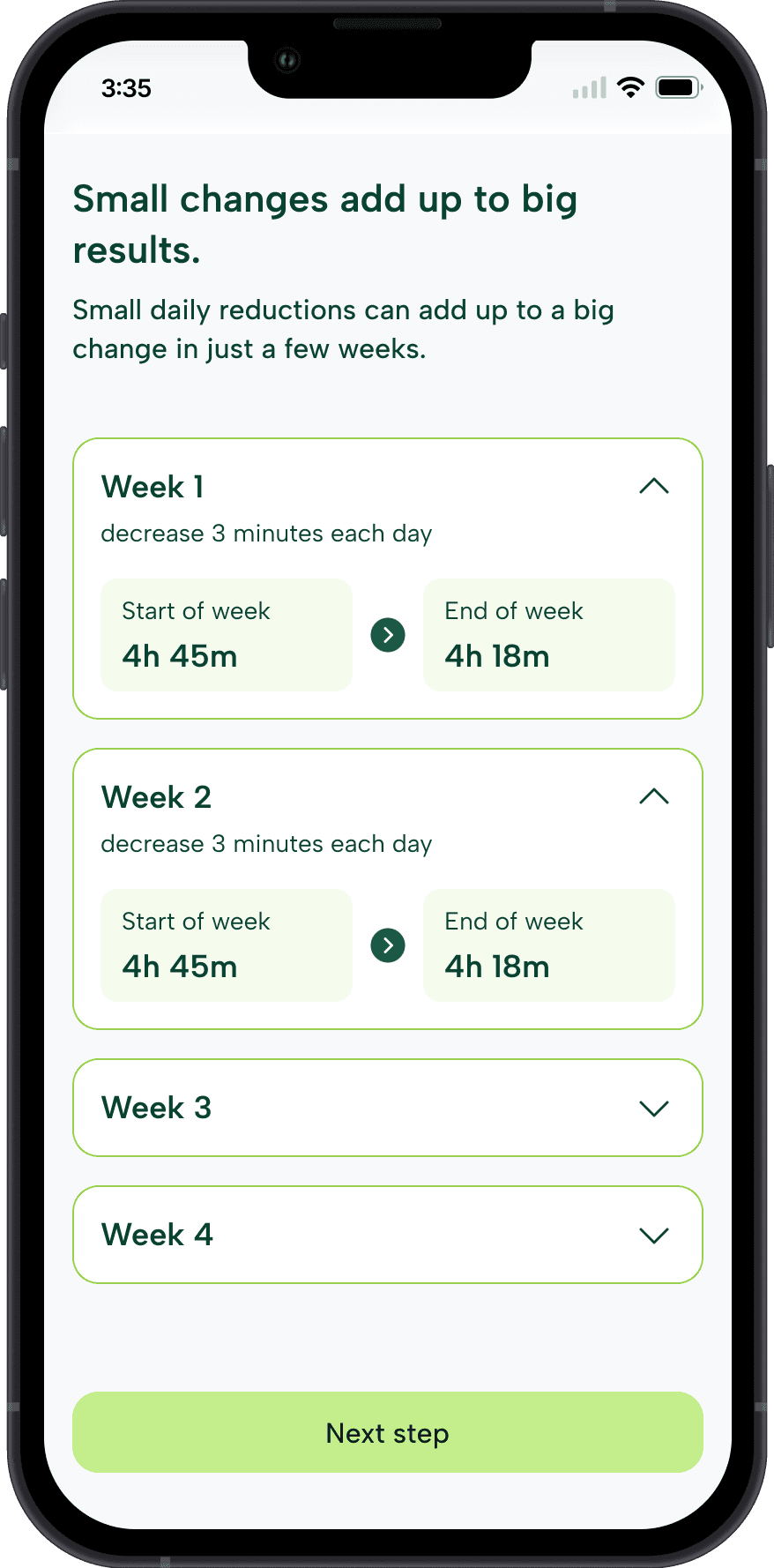
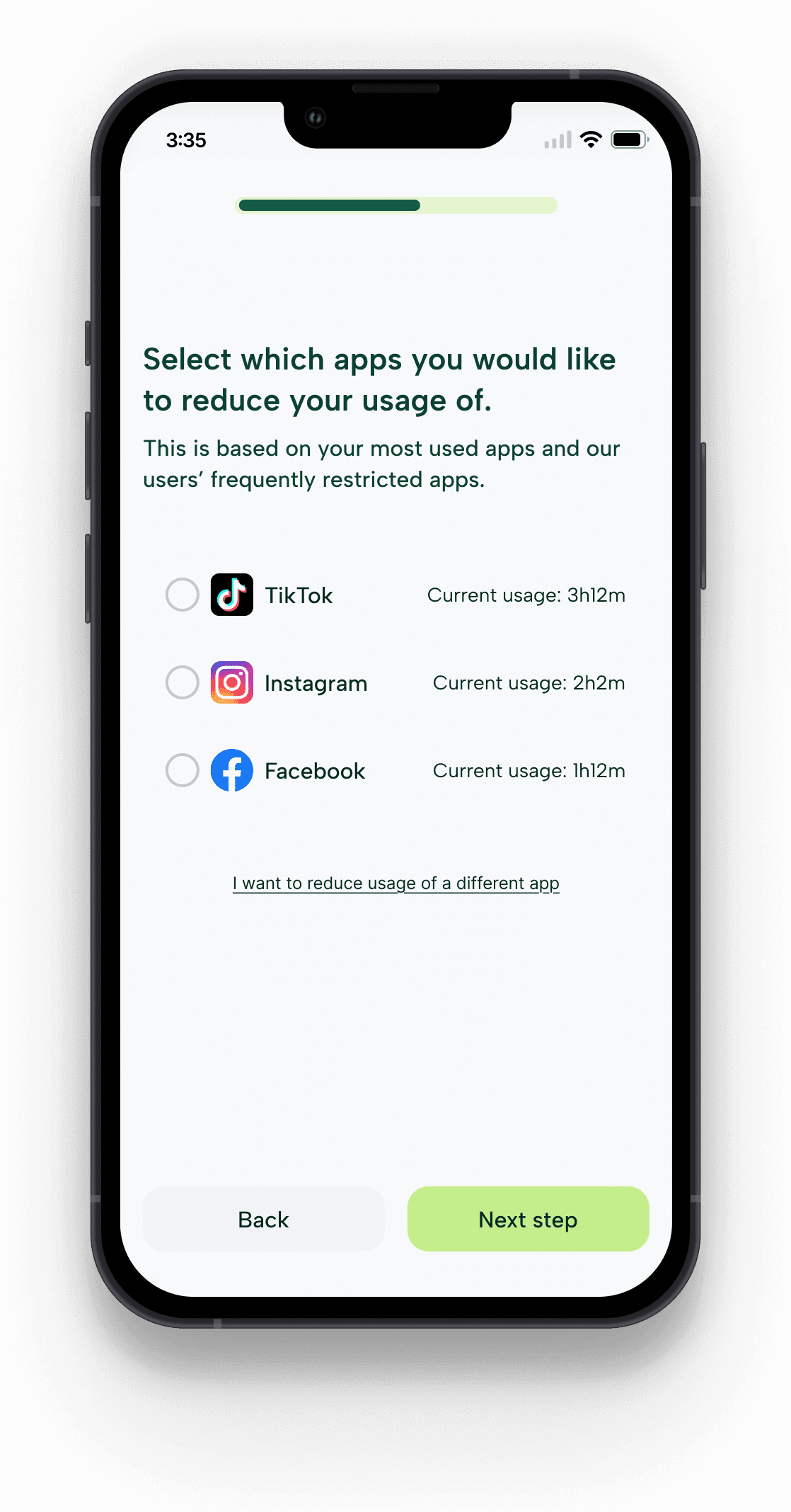
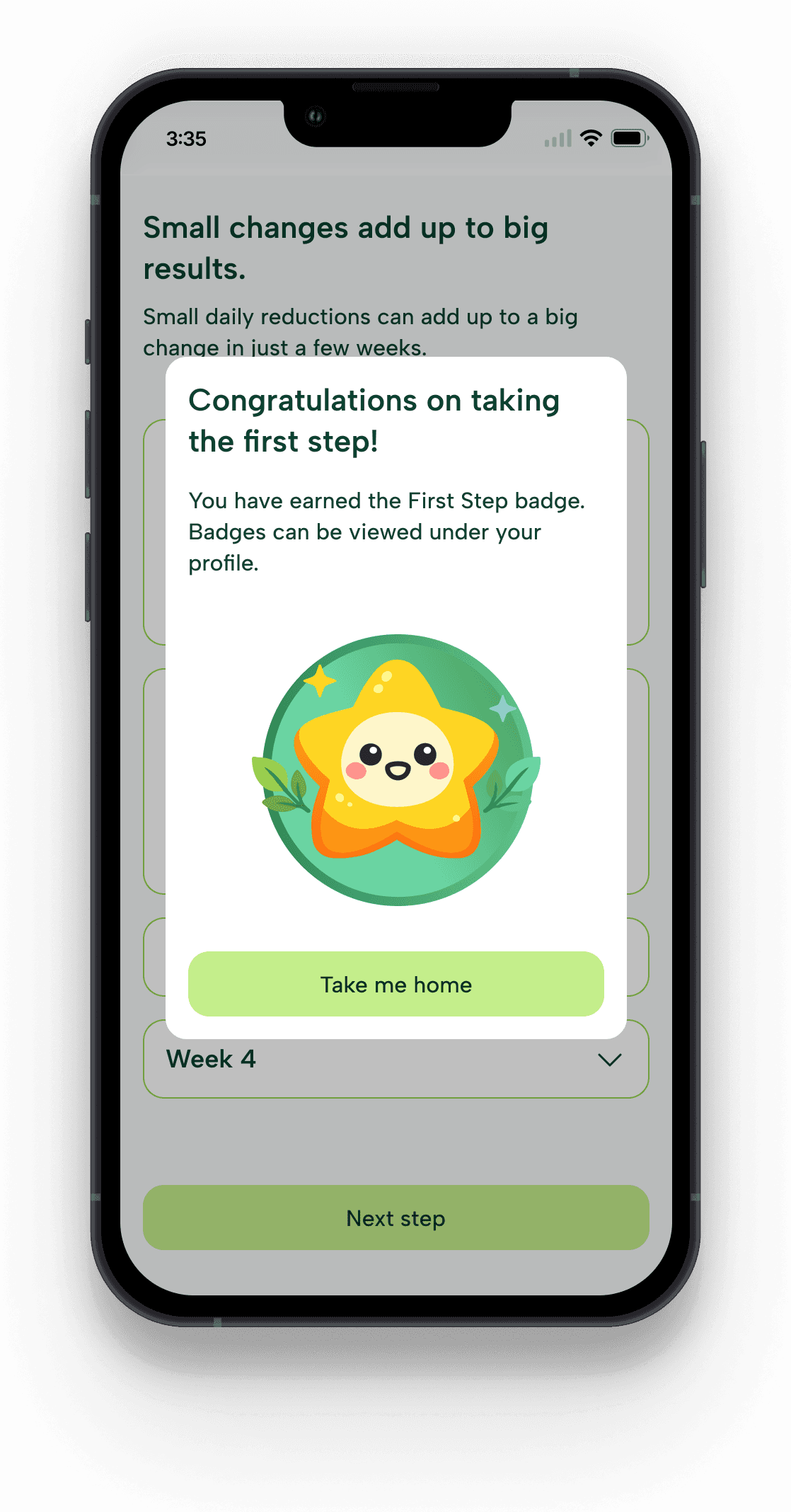
A friendly onboarding process with a weekly plan
The onboarding has a step-by-step process that allows users to identify their goal for usage of certain apps, set a restriction for that app, and review a weekly plan for gradual usage reduction. The weekly plan shows users that with small daily reductions, they can lower their usage over time without needing to make a dramatic lifestyle change all at once.
Gentle restrictions and realistic alternatives
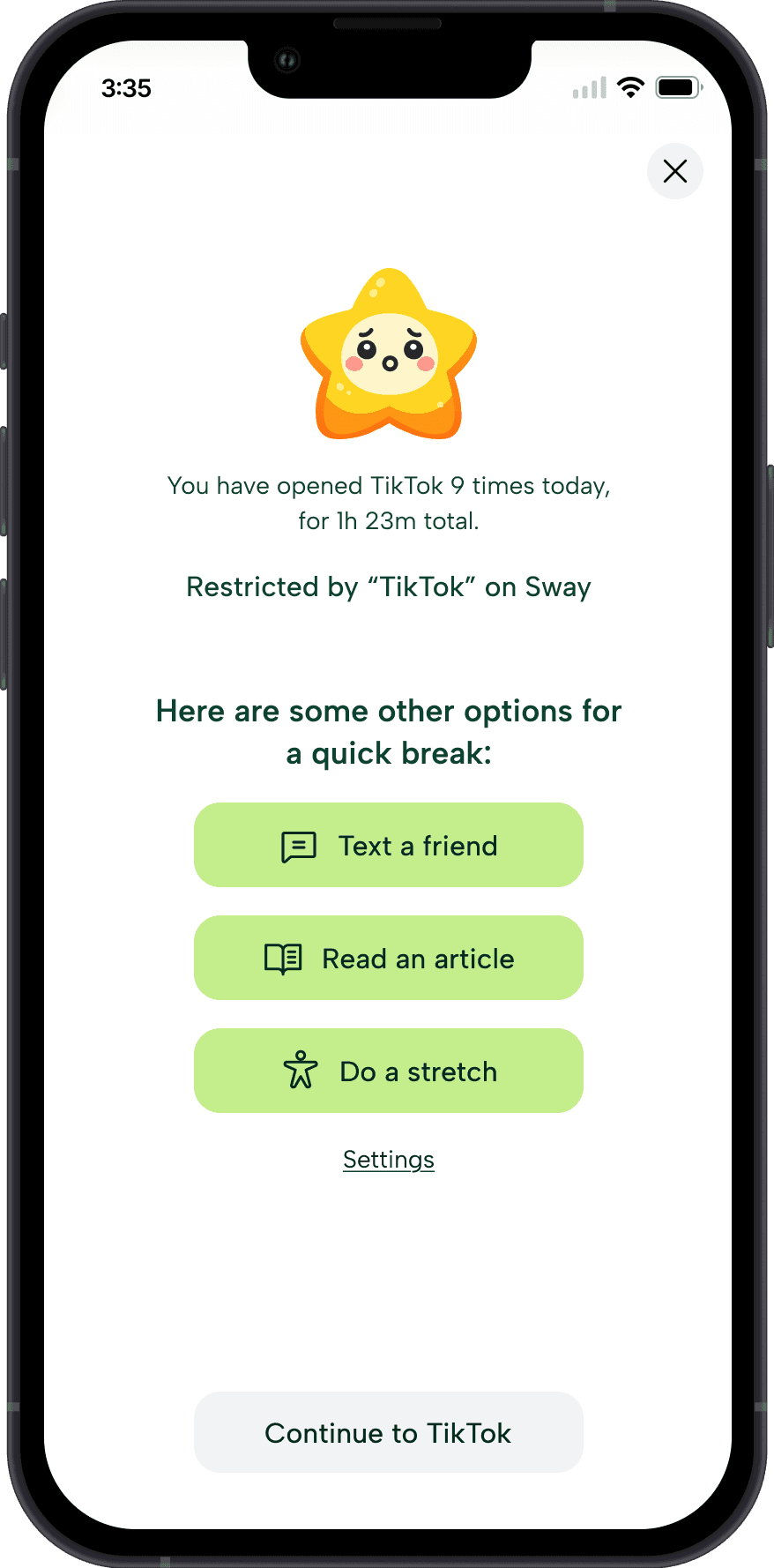
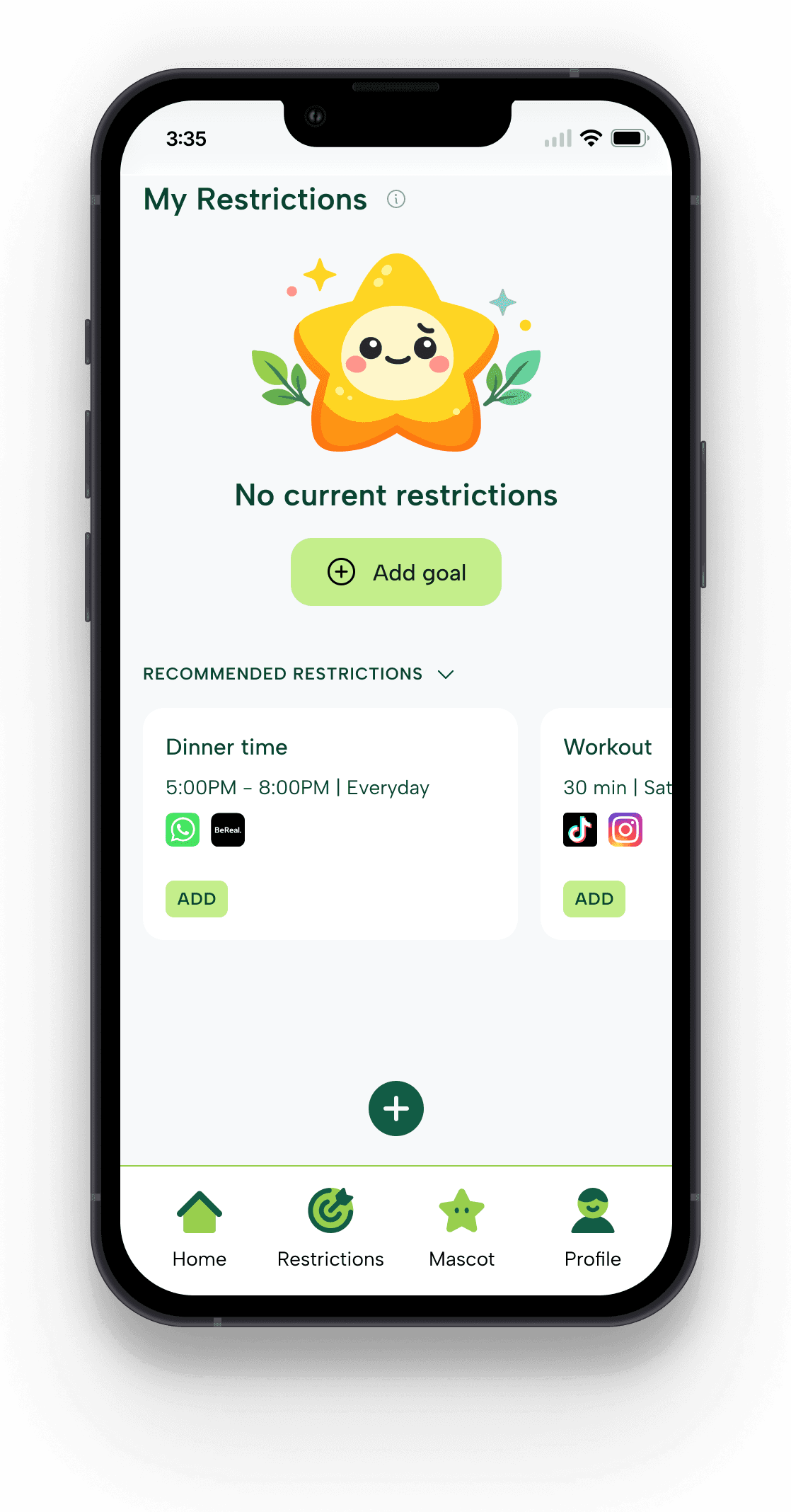
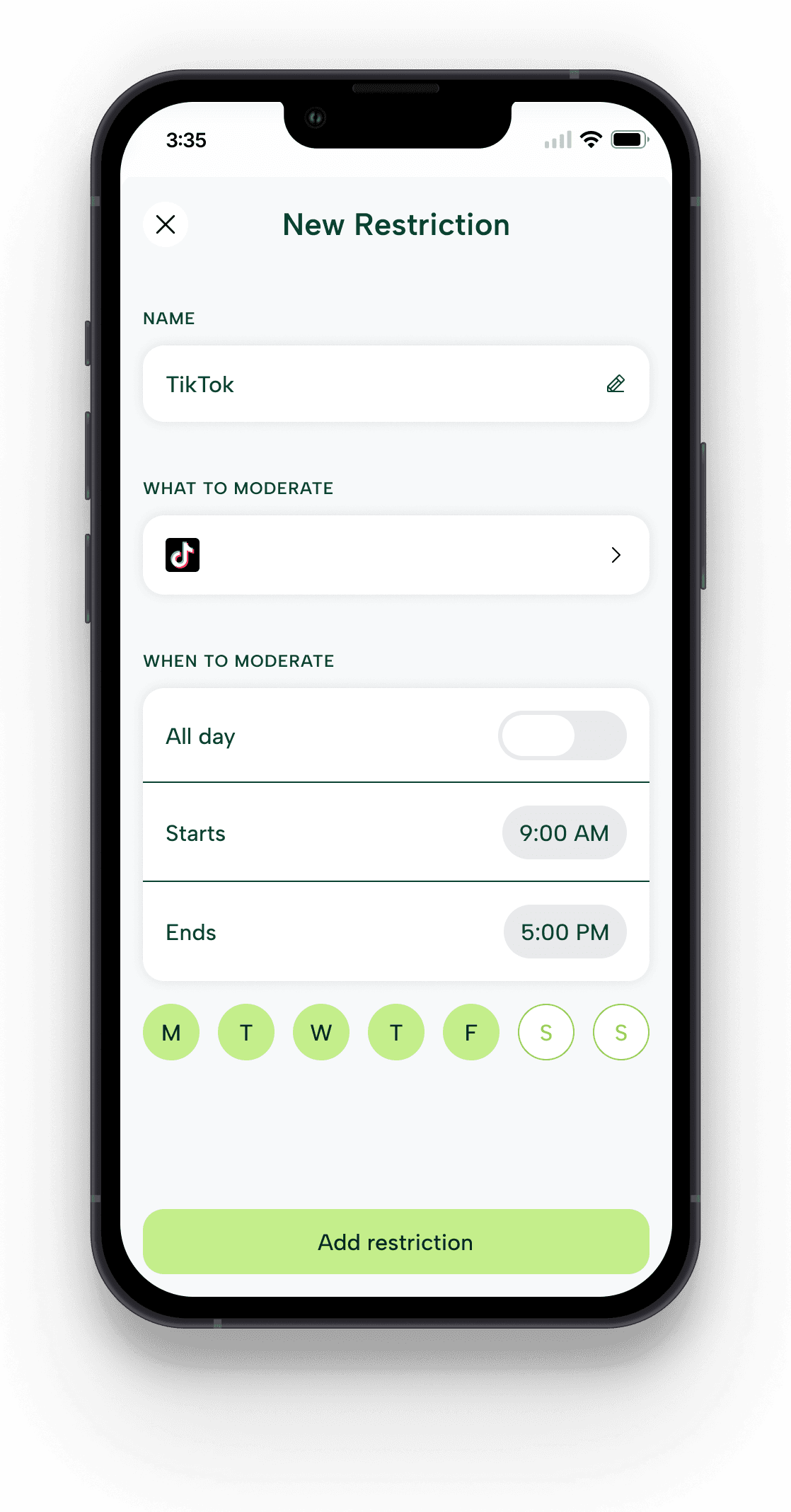
Rather than hard blocks, users can set up "restrictions" for scheduled times/days, or after a designated amount of app usage. During restricted times, Sway provides suggested alternatives when the user tries to open the restricted app, such as texting a friend, reading an article, or doing a stretching video online. While existing apps offer alternative suggestions to a blocked app, they are often hobbies like "hiking" or "watch a show" that require more time commitment than a quick social media break does.
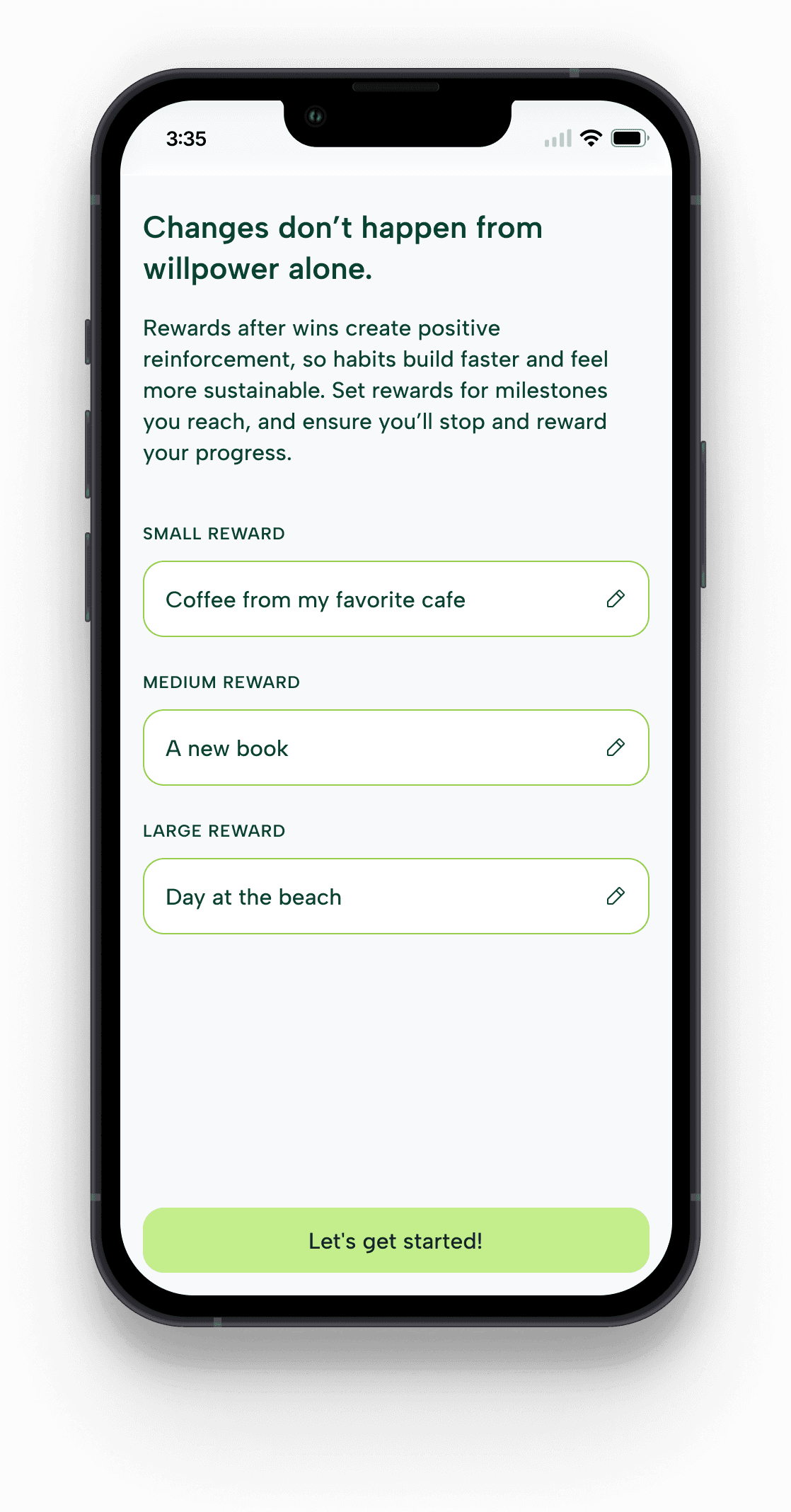
Rewards
Users receive a star for each day they meet their goal. When they're ready to treat themselves, they exchange stars for one of the rewards they selected during the onboarding process.
Users had underwhelming reactions to the real-life reward model of positive reinforcement
With the high-fidelity functional prototype, I conducted another round of usability testing to evaluate:
How easily users could complete onboarding and goal setting
How helpful the rewards felt in motivating users to stick to their goals
How effective the alternative suggestions were in redirecting users
Whether language issues from mid-fidelity testinghad been resolved
Metrics
5 out of 6 participants completed onboarding with fewer than 2 misclicks
Users rated goal setting 4.7/5 for ease of use
Users rated the alternatives 4.75/5 for helpfulness in redirecting them away from a restricted app
Participants had mixed reactions to how helpful the rewards would be in motivating them to stick to their goals. Because the rewards were self-provided, participants felt uncertain about whether they would actually follow through or find the rewards motivating enough over time.
They did, however, respond very positively to the star mascot. One participant, who was unfamiliar with the earlier concept of a “virtual pet”, even suggested a similar concept using the mascot, which could “level up” as the user sticks to their goals. That response pointed to a new insight. Motivation might not come primarily from transactional rewards, but from a sense of encouragement, fun, and visible progress.
Revisiting the concept of an anthropomorphic mascot
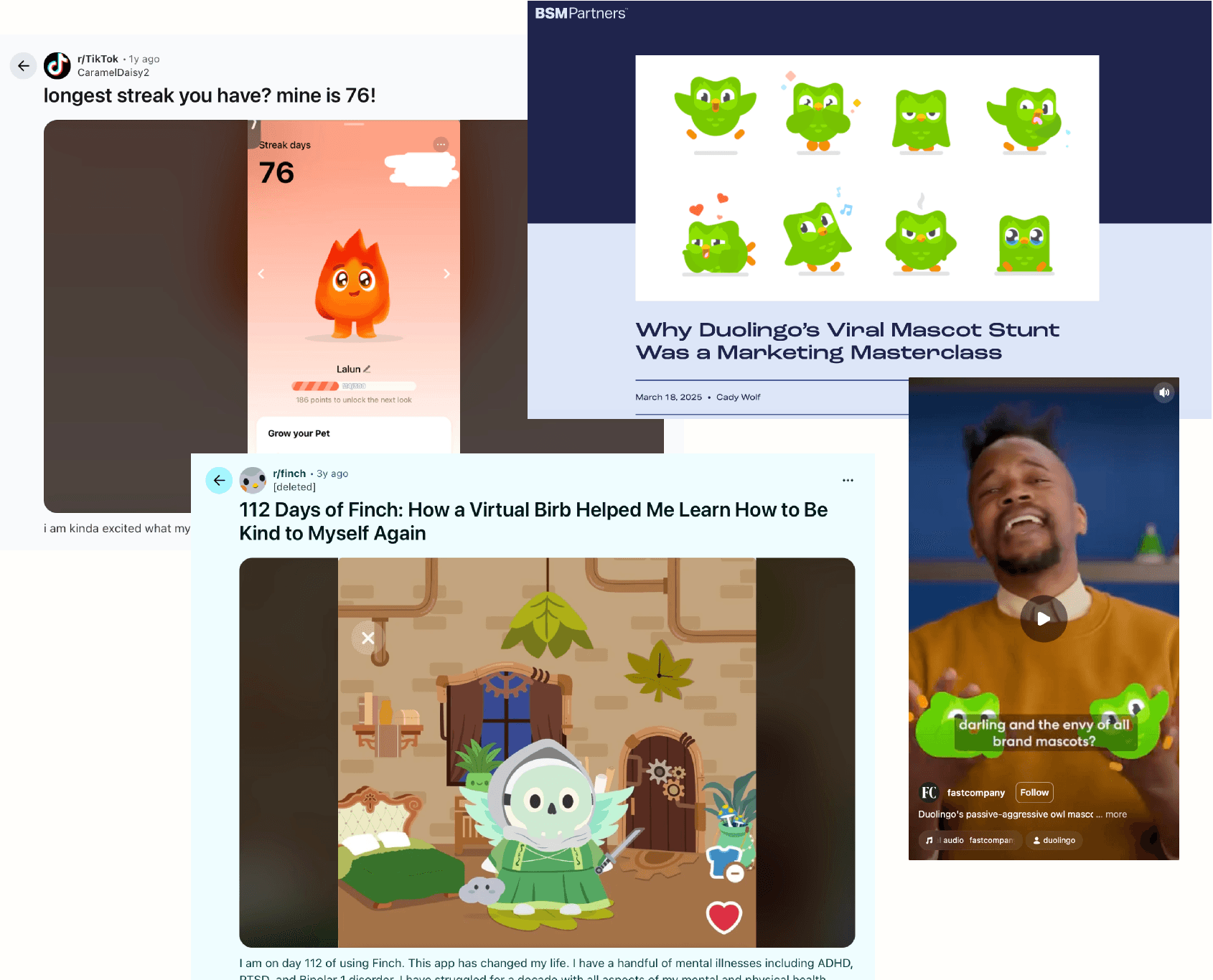
Because the mascot resonated so strongly, I revisited the role mascots play in motivating behaviors and emotional attachment in digital products.
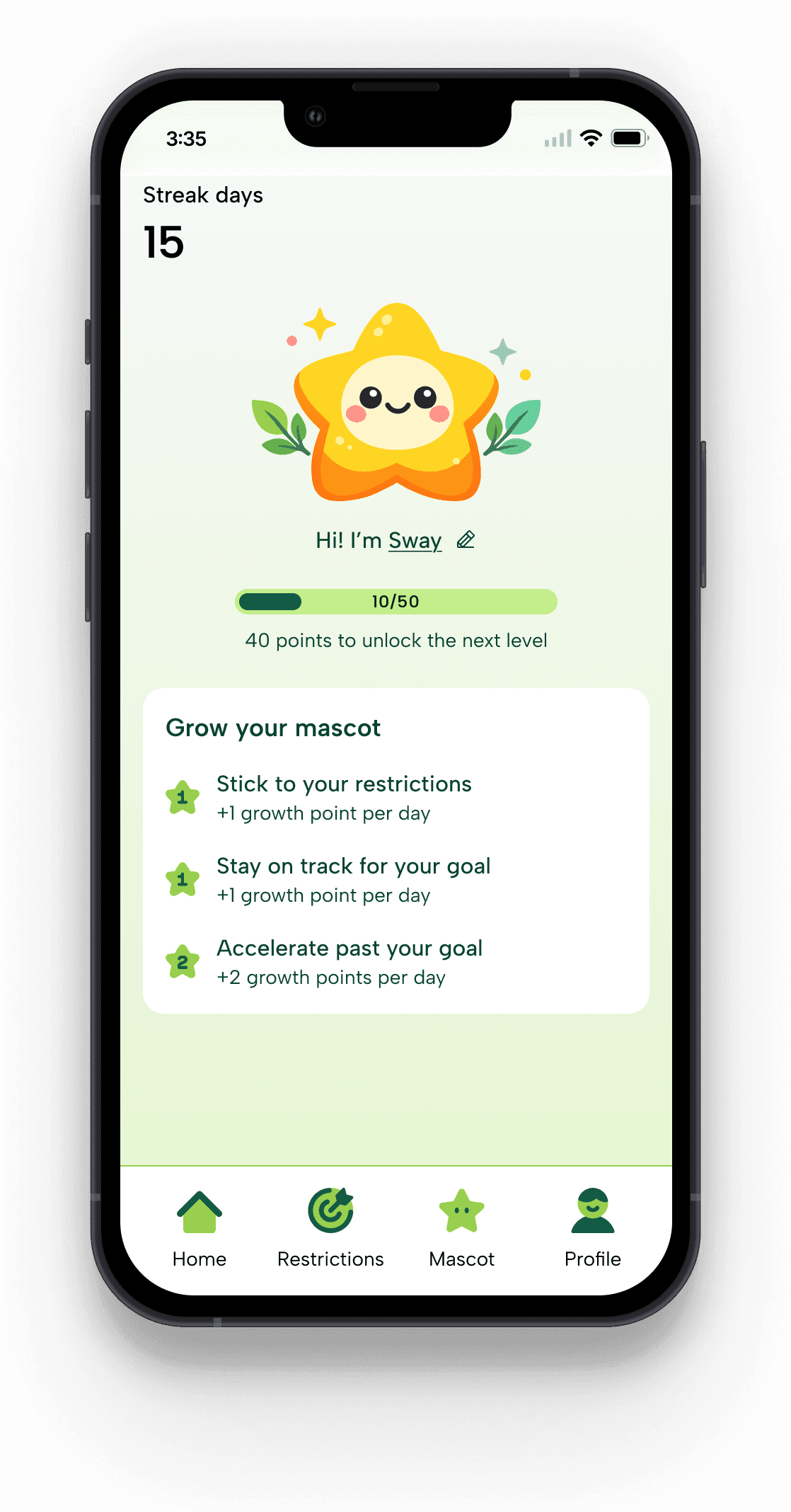
Rather than return to my previous concept of the mascot as something that required user interaction, I prototyped the star mascot as a passive encouragement feature. I also made additional changes to:
Clarify steps of the onboarding process
Improve the visual hierarchy of information
Refined the language to feel more friendly, encouraging, and aligned with the brand values
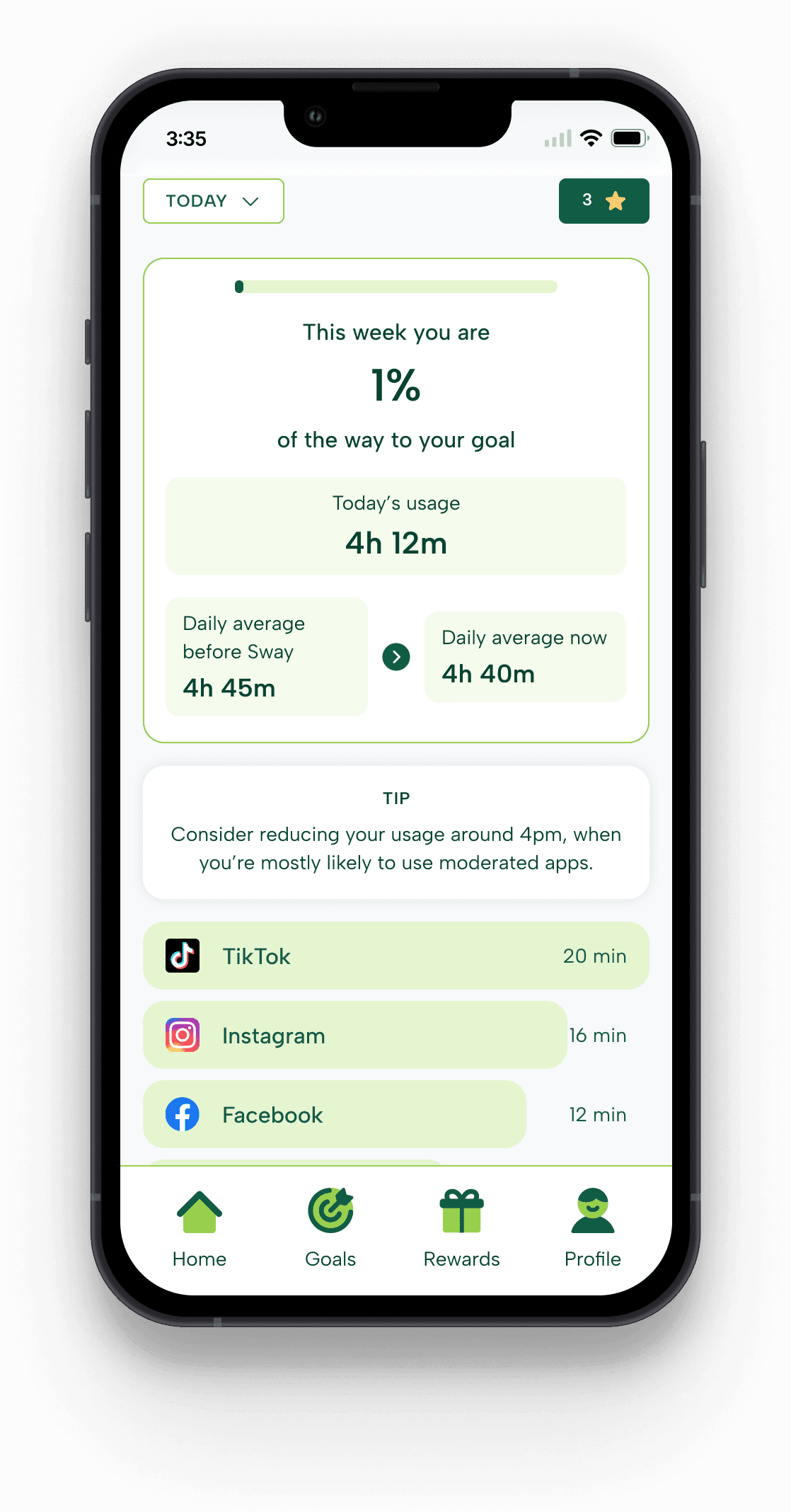
Before
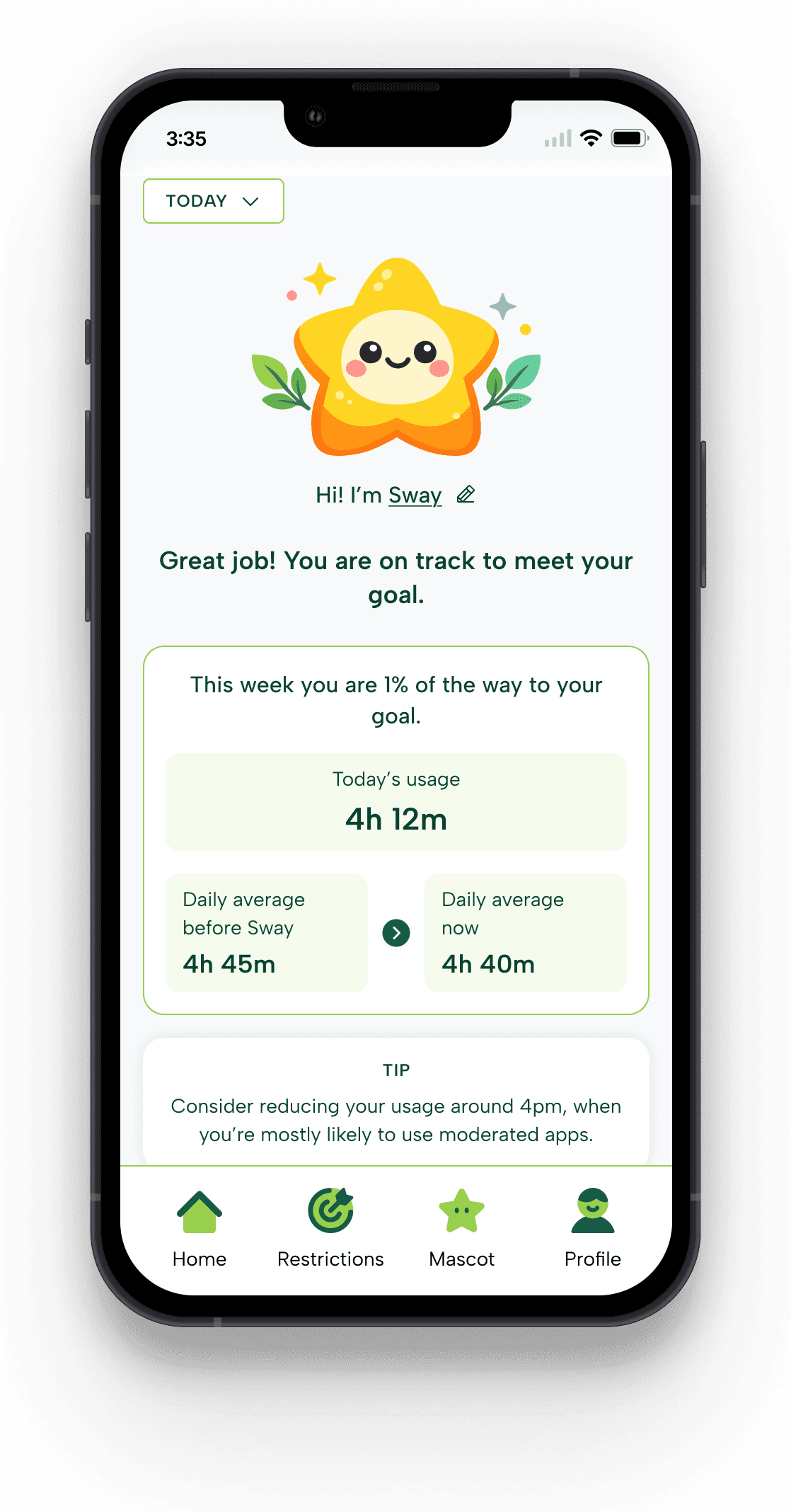
after
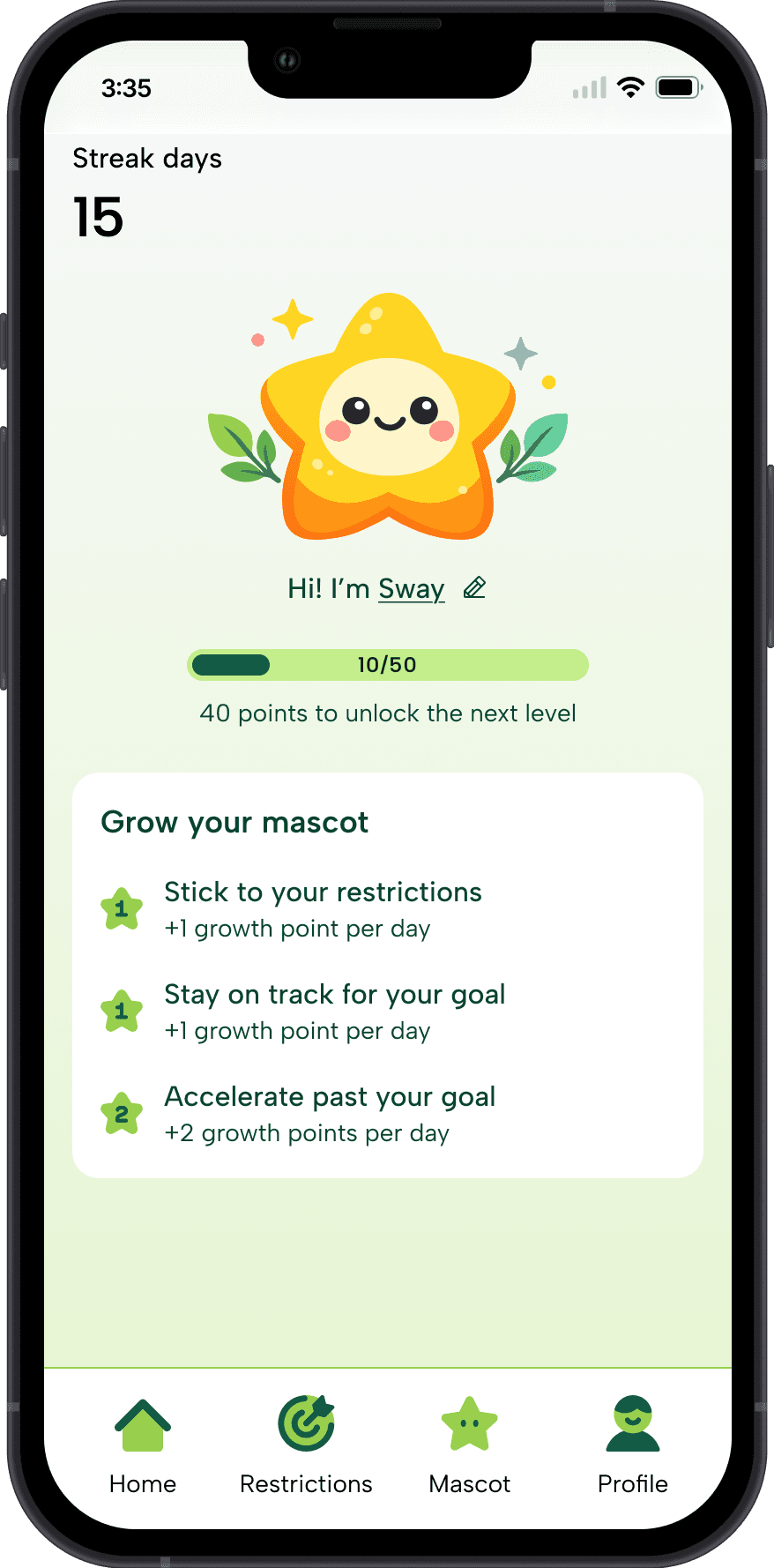
The home page was adjusted to include the mascot and allow the user to name them for more personalization.
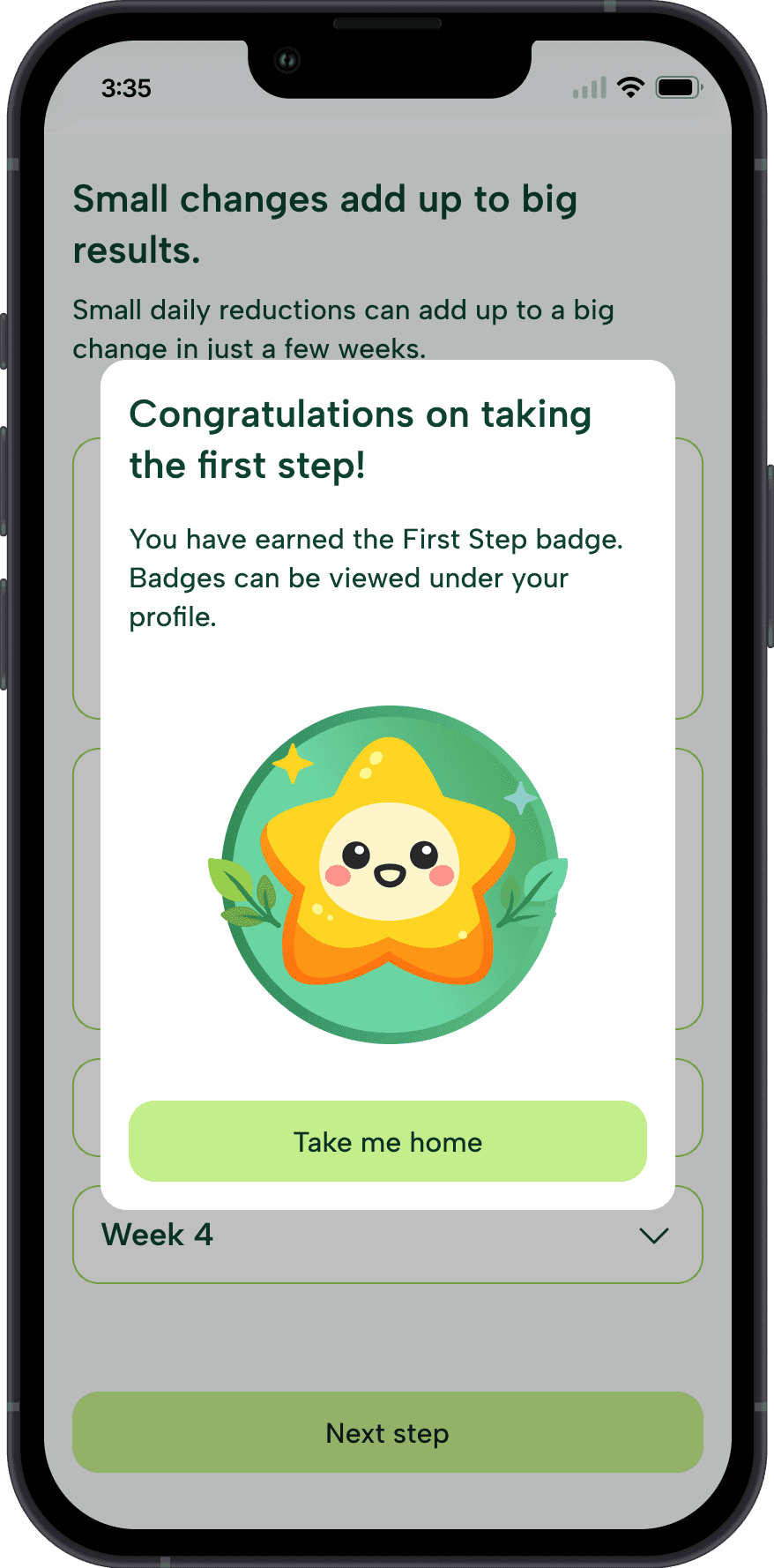
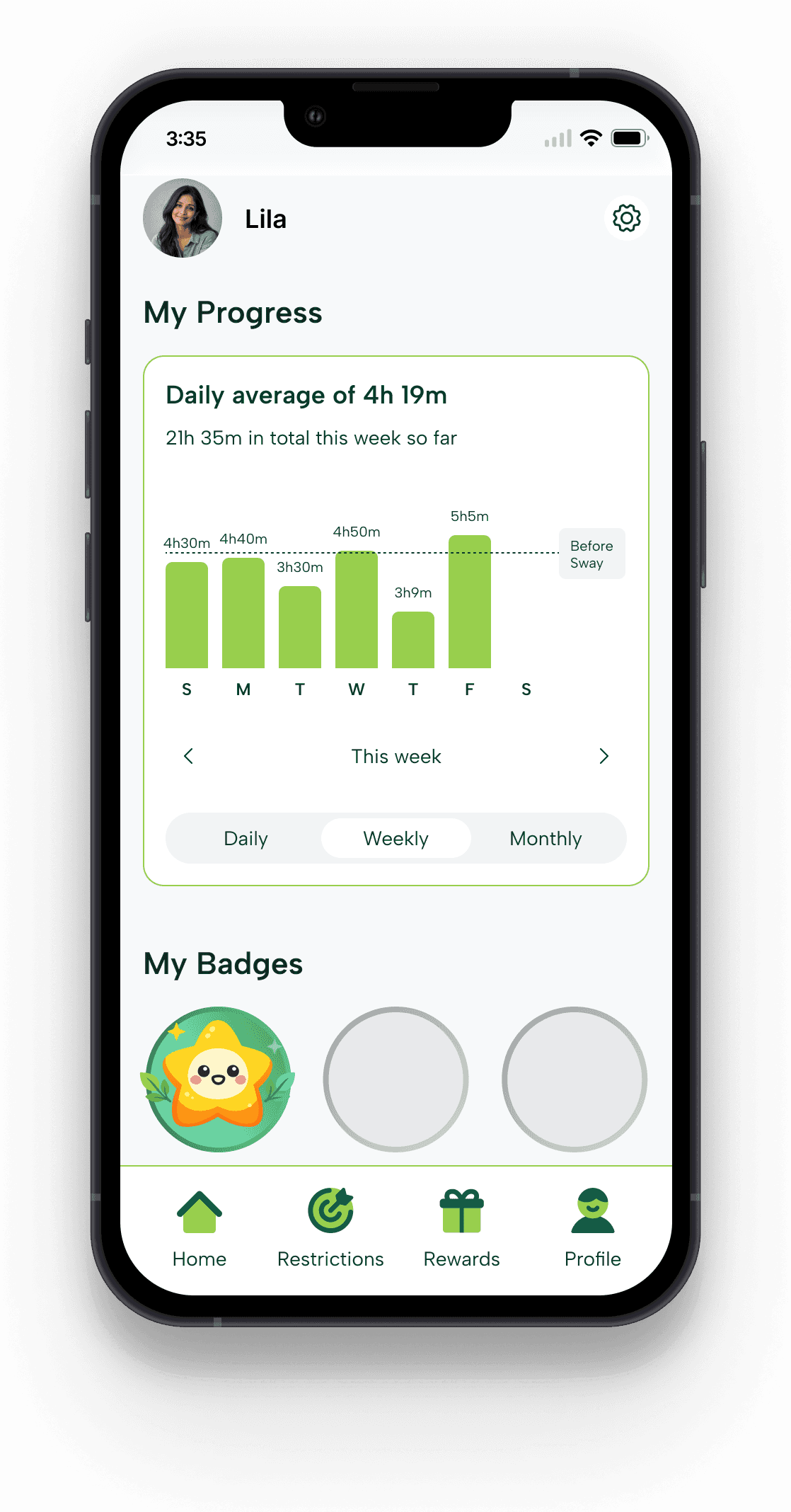
A mascot detail page was added to replace the previous rewards page. Badges earned were added to the profile page.
Outcome
Designing social media reduction around encouragement, not restriction
This project resulted in a concept for reducing social media use that approaches behavior change through encouragement rather than control. Instead of centering the experience around hard limits or punishment, the design focused on gradual reduction, low-lift alternatives, and positive reinforcement to help users make different choices in the moments when social media use is automatic.
The research revealed a key tension: users were already aware that social media was affecting their wellbeing, but existing tools often failed because they felt too rigid, guilt-inducing, or easy to override. By reframing the problem through a harm reduction lens, I designed a more flexible approach. Usability testing surfaced an unexpected finding that emotional tone mattered. Users responded strongly to a sense of warmth, whimsy, and encouragement.
Next steps
More research would be required to determine which form of positive reinforcement is most likely to drive long-term change. Because motivation is highly personal, additional A/B testing across a broader sample could reveal whether users respond more strongly to self-set rewards, mascot-based progress systems, or another model entirely.
I would also want to test the concept longitudinally. Since the product is designed around habit change, its success would depend on whether users reduced usage over time, overrode limits less often, and felt better about the process.
Finally, I would explore structured prioritization methods such as a Kano model questionnaire to identify which features create the most meaningful value, particularly when balancing delightful features like the mascot against more functional behavior-change mechanics.